Why Most Market Entries Fail
According to a Bain & Company study, more than 60% of geographic expansion moves fail entirely, and only 17% of the companies studied achieve sustained, profitable international growth. After helping established companies and startups expand into foreign markets, we began to understand why.
Many companies are not ready to enter new markets. It is very common to underestimate the effort required and face early disappointment.
Other companies understand what expansion involves and have the required capabilities, but do not conduct proper research to assess potential markets, understand their characteristics, and define a clear strategy. This can eventually lead to entering the wrong markets or failing to adapt to the needs of local customers. And because many companies decide to commit substantial resources to entering new markets right away, without validating their assumptions first, they often end up losing a lot of money.
Some companies simply fail in execution. They do not have the required capabilities to attract customers or convert them into sales, do not adapt their product and processes to the new market, or simply fail to execute a well-crafted plan.
The good news is that there are some simple steps companies can take to increase their chances of successful international expansion, or at least reduce their financial losses if it still fails.
At LIMEN, we have helped dozens of companies of different sizes enter new markets. The clients we supported with market-entry strategy or implementation generated more than €1 billion in revenue in the new markets they entered. Based on that experience, we use a six-step framework for planning and executing international expansion.
A market entry strategy is a practical plan for selecting a target market, deciding how to enter it, validating demand and scaling investment based on the results.
The Six Steps of Entering a New Market
Here are the six steps we recommend following when entering a new market:
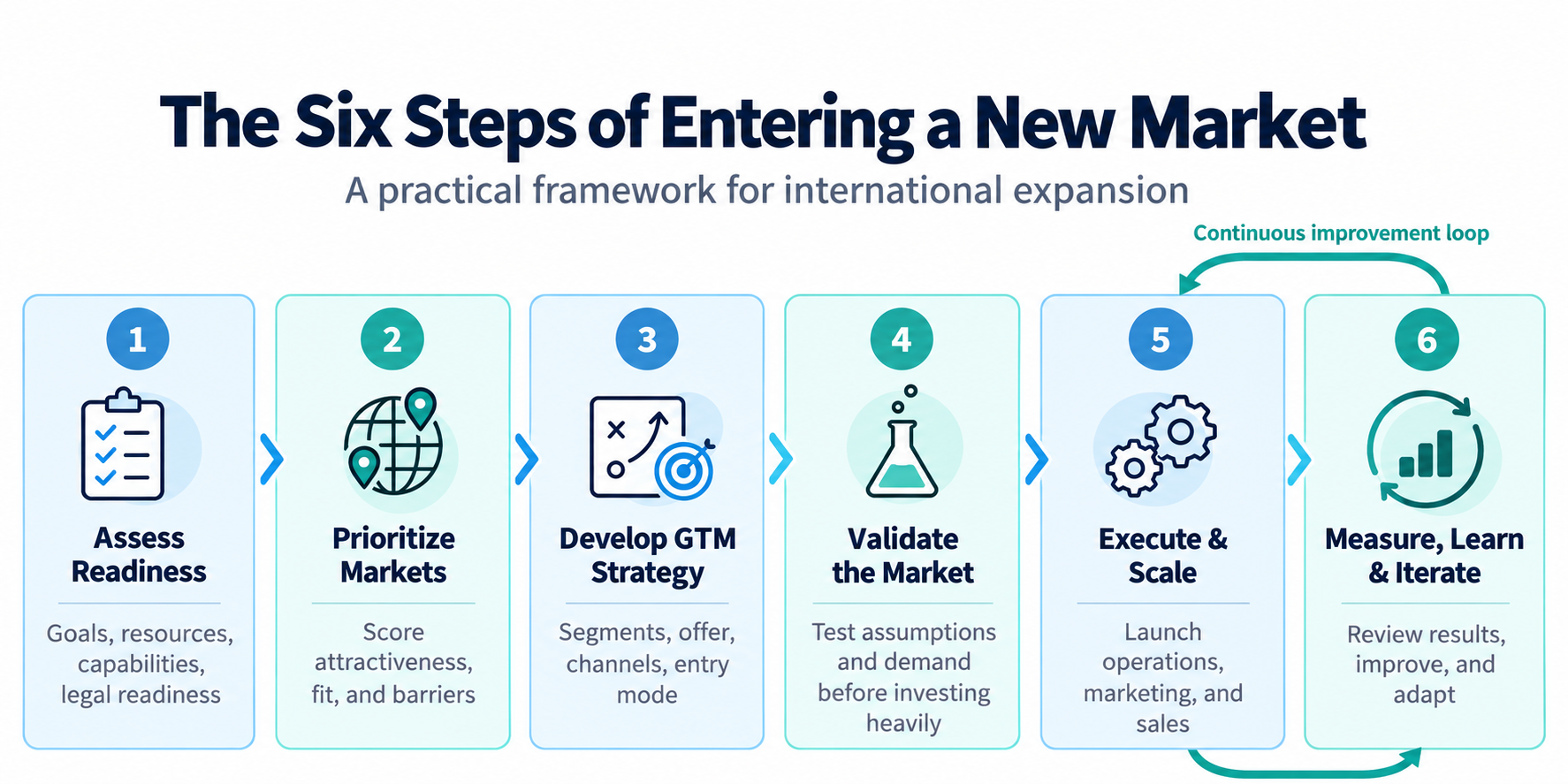
The six-step framework for international expansion.
-
Assess readiness. Understand whether your company has the required resources and capabilities to enter new markets.
-
Research and prioritise markets. Compare potential markets and select the ones that are the best fit for your particular business.
-
Develop a go-to-market strategy. Deep dive into the selected market or markets and define exactly how you are going to enter them: target segments, products, marketing and sales channels, and operational model.
-
Validate demand. Test the main assumptions behind your strategy and assess market demand through small, controlled experiments before committing substantial resources.
-
Execute and scale. Implement your strategy and gradually increase your marketing, sales and operational efforts to achieve the desired scale.
-
Measure, reflect and iterate. Track your actual market-entry results, learn from what works and what does not, develop and test new hypotheses, and continuously improve your approach.
The last two stages are closely connected and iterative. You implement your strategy, measure the results, reflect on them, develop new hypotheses, and continue improving until you establish a successful presence in the market. Market entry is rarely an overnight success. It is usually a longer process of gradually achieving your goals.
Step 1: Assess whether your company is ready to expand
One thing companies often overlook is checking whether they are actually ready to enter new markets. There are some basics that should be in place to give the expansion a reasonable chance of success. If they are not in place, there is usually little sense in moving forward before addressing them.
Entering new markets requires several things:
-
Clear shared goals. It all starts with having a clear understanding of why you are expanding and internal alignment around the goals of the expansion. Ask yourself: Why do we want to expand into new markets? What are the main results we want to achieve, and within what timeframe? It is equally important to make sure that different members of the team share the same understanding of these goals.
-
Available resources. Next, the company needs to check whether it has the resources required to achieve its goals. A very common mistake is to set ambitious expansion targets without being prepared to invest the resources needed to achieve them. The key is to compare your goals with the resources you actually have available and understand how realistic the plan is.
-
Product maturity. Another important element is the maturity of your product and the capabilities behind it. Ask yourself: Is the product itself ready to scale? Can your internal processes handle a larger customer base? We often see companies that have not yet achieved product-market fit in their existing market but already want to expand internationally. In such cases, expansion rarely solves the underlying problem. New customers do not stay and the company simply wastes money acquiring customers that it cannot retain.
-
Commercial capabilities. Another key question is whether the company has the commercial capabilities required to attract and close customers in the new market. Some markets might require local sales representation, while others could require specific marketing capabilities. Otherwise, you risk entering a new market with a leaking bucket: you invest in acquiring new customers, but your existing commercial process is not efficient enough to convert them.
-
Team and operational capabilities. You also need to assess whether the founders and the wider team are ready for the expansion. These requirements will differ significantly depending on the business, but it is important to identify them early. One common mistake is that founders underestimate how much of their own time a market expansion will require.
-
Legal readiness. Finally, you need to understand whether there are any legal or regulatory requirements that could prevent or significantly complicate the expansion. Depending on the market and industry, you might need to establish a legal entity, obtain certain licences, secure certifications, or fulfil other requirements before you can operate there. This does not necessarily mean that everything must already be in place before you start. However, you should understand what is required, how difficult it will be to obtain, and how you are going to address it.
If you do not identify any major issues in these areas, you can confidently proceed to the next stages. If you identify serious blockers, it usually makes sense to resolve them before moving forward.
This is why an expansion readiness assessment is important. It can help you identify problems that could increase the time and cost of the expansion or make it unfeasible. We saw this while scaling an international B2B marketplace.
We received good initial feedback from several markets and decided to expand further. However, once we moved ahead, we quickly realised that some of those markets had legal and technical requirements that we had not fully considered. We had already started investing and had to delay the rollout while we adapted to those requirements. If we had conducted a more thorough readiness check upfront, we could have identified those gaps earlier and avoided much of the delay and unnecessary investment.
Step 2: Research and prioritise foreign markets
Once you have established that you are ready for expansion, the next question is: where are you actually going to expand?
This is a very important decision. If you enter a declining market or one without your target audience, your experience and results are likely to be very different from entering a growing market with strong demand for your particular product.
Despite that, companies often make this decision based on personal preferences or anecdotal recommendations. Somebody tells them that a certain country looks interesting, or a founder simply wants to work in a specific market because they like the country. That is not necessarily the most rational way to approach market selection.
What we usually recommend is a structured prioritisation of potential markets:
Define the selection criteria
Start by defining the criteria you are going to use to evaluate potential markets. Some criteria are relatively standard, while others should be specific to your business and industry. We usually define 4–7 criteria that we use to score the markets. They can be divided into two groups.
Market attractiveness
-
Market size and growth rate. First, look at the overall market size and growth rate. Is the market large enough? Is it expanding or declining?
-
Profitability. You could also consider profitability and willingness to pay, as they contribute to the overall profit you can expect.
-
Addressable market. You can then go one level deeper and estimate your addressable market. Unless you are targeting the entire market, its overall size does not tell you how much opportunity there actually is for your company. Define your target audience and try to understand how large that specific segment is.
Market fit and accessibility
-
Competition. Next, look at the competition. A market might be large but already have strong, well-established competitors. Another might be smaller but growing, with less competition. If you do not yet have a strong brand or a product with clear advantages over competitors, you might want to avoid making an extremely competitive market your first international expansion.
-
Barriers to entry. Then assess the barriers to entry. These could include legal requirements, customers being locked in with existing competitors, or cultural barriers. In some countries or industries, for example, you may need a local presence and business development in the local language to sell successfully.
-
Market fit. Finally, depending on your business, you can also try to assess how well your product fits the needs and expectations of customers in each market. This is sometimes more difficult to quantify, but it can still be an important selection criterion.
Score and shortlist the markets
Once you have defined the criteria, you can research and score the markets that make sense to consider. You will then be able to compare them in a more structured way rather than relying only on personal opinions. We usually start with a broad range of markets, often 30–50, and then narrow the initial selection down to around 5–10 markets, sometimes even 3–5, before conducting a deeper analysis of the remaining options.
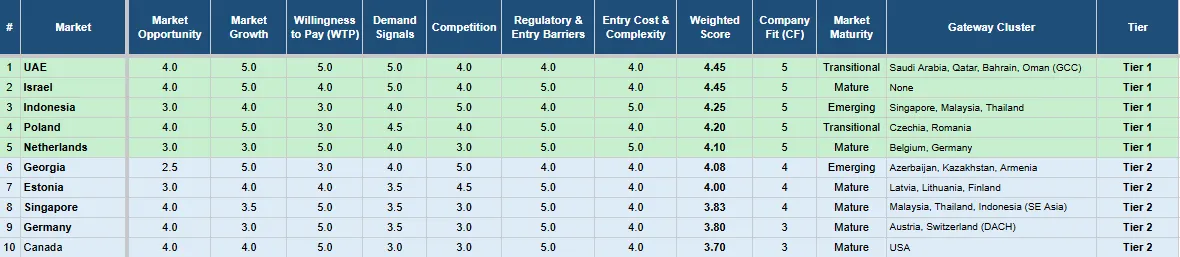
An example of a weighted market-prioritisation scorecard.
Validate the shortlist and align internally
With a shortlist of 5–10 markets and a better understanding of those markets, you can organise an internal strategy session within your company. Present the findings, explain the rationale behind the proposed priorities, and discuss the options with the team. The final outcome should be an agreed selection of the market or markets you want to enter.
Choosing only one market as your initial priority can be entirely sensible, especially when your resources are limited. However, you might also want to keep 2–3 markets at this stage and deep dive into them in the next step.
In practice, this kind of structured prioritisation can save a company from investing in the wrong market simply because it looked attractive at first glance.
Step 3: Develop your go-to-market strategy
After you have assessed your readiness and selected the markets, the next step is to define how exactly you are going to enter them.
Research the target markets
-
Understand the market landscape and segments. Start by reviewing the size of the market, but this time in much greater detail. Assess not only how large the market is, but also what different segments exist within it. The goal is to understand what the market actually looks like and which segments might be the most interesting to target.
-
Research your customers. Once you have identified the key segments, analyse the customers within them. Who are they? What are their specific needs and preferences? You should also look at their buying behaviour and how they make purchasing decisions. Speaking directly with potential customers and other people in the market can be very useful alongside desk research. All this information will help you later define which customers you want to target and how exactly you can reach them.
-
Research your competition. Competition is actually one of the most valuable sources of market intelligence. Identify the key competitors, the segments they target, and the products they offer. You can benchmark their products against yours and study the marketing and sales channels they use. When looking at competitors, it is important to distinguish between what you can observe and what you can actually confirm about their results.
-
Understand the barriers to entry in detail. We already looked at barriers to entry during market prioritisation, but that was only a high-level assessment. Now you need to understand them in detail. Explore the specific legal, regulatory, commercial, operational and cultural barriers that apply to your chosen market. More importantly, understand what you would need to do to overcome them. This will directly influence your entry strategy and the resources required to execute it.
Turn the research into strategic decisions
At this stage, you have collected quite a lot of information. But research alone is not yet a strategy. A good market research report can tell you what is happening in a market. A strategy goes one step further: it makes explicit choices about what you are going to do, where you are going to focus, what you are not going to do, and how you expect to win. Many companies confuse research with strategy, but the real value comes from translating information into decisions.
The main decisions you need to make are:
-
Target customers. Which segments and customer profiles are you going to prioritise?
-
Product offering. Which products or services are you going to offer to those customers?
-
Marketing and sales channels. Through which channels are you going to reach and acquire them? Ideally, define this by segment where relevant.
-
Pricing. At what prices are you going to offer the products, taking into account your research and competitive benchmarking?
-
Positioning and differentiation. How are you going to position the business, and what are the key reasons for customers to choose you rather than your competitors?
-
Mode of market entry. How are you going to enter the market, and how are you going to organise your operations?
-
Barriers to entry. How are you going to overcome the obstacles you identified during the research?
-
Business case. How do you expect to make money? What level of revenue, margin and customer acquisition economics do you expect? How much investment will be required, how long will it take to reach scale or break even, and by when do you expect to achieve the key financial milestones?
Select the mode of market entry
The options here can differ quite significantly depending on your business model, industry and target country. A business may enter through cross-border sales, distributors, licensing, contract manufacturing, local partners, a joint venture, or its own subsidiary. The right approach depends on the strategy and the specific circumstances of the market.
Align the team and create an execution plan
Sometimes, after completing the research, the right strategic direction becomes quite clear. But quite often, several reasonable strategic options emerge. In that case, define those options, bring the team together for a strategy session, discuss their implications, and agree on which approach to pursue.
Once you have aligned internally, finalise the market-entry strategy in a shared document and get it approved. Then translate it into a practical execution plan with clear activities, timelines, responsibilities and required resources. We usually organise strategy sessions at this stage to make sure that everyone is aligned on the strategy. In some cases, we have to organise several sessions because of differing views. And this is not necessarily a bad thing, as it often helps to further refine and finalise the strategy.
At this point, you should have a good understanding of which customers you are targeting, what you are offering, how you are going to reach them, how you will differentiate yourself, how the business is expected to make money, and how exactly you will establish your presence in the market.
Step 4: Validate demand before committing substantial resources
This is not a step that everyone includes in their market-entry process, but at LIMEN we consider it essential.
Some companies develop their strategy and then immediately enter the new market with full-scale resources and investment. The problem is that, no matter how much analysis you have done, you can still miss something important or misunderstand how the market works in practice.
For example, you might have a great product and expect to sell it successfully in a new country. But once you start, you may discover that the market is highly relationship-driven and that, without somebody local who already has the right connections, it is very difficult to generate any sales.
That is why we usually recommend starting with a relatively small market test. The idea is to validate the assumptions behind your strategy and check whether there is actual demand before committing substantial resources.
The way you do that can differ significantly by industry.
Acquire the first few customers
For some businesses, particularly SaaS or other products that are relatively easy to sell and deliver across borders, market validation can be quite straightforward. Choose one or several marketing and sales channels that allow you to reach potential customers relatively quickly.
Test the demand without fully fulfilling the orders
Things can become more complicated when your business involves physical goods, manufacturing, or local infrastructure. If your eventual market entry requires a production facility, you probably do not want to build one just to test whether people are interested in buying your product. There are several alternatives you can consider.
-
Speak with potential customers. You can start by interviewing customers and understanding whether your product resonates with them and whether they would consider buying it. This is not the most reliable proof of demand, but it is still better than investing heavily without testing anything.
-
Pre-sell or sign letters of intent. Startups often do this before their product is fully developed. A prospective customer’s willingness to make a preliminary commitment can be a useful signal, although a letter of intent is not necessarily the same as a completed sale.
In practice, there are also intermediate ways to validate demand before building your own full operation. For example, for one fashion brand we first spoke with other brands that had recently launched in the market to understand whether the entry was still feasible and what challenges they had faced. Then, instead of investing immediately into our own direct-to-consumer setup, we selected one B2B channel and one B2C channel to test demand: a marketplace on the B2B side and a distributor on the B2C side. This allowed us to validate the initial demand before investing into our own direct-to-consumer presence. This kind of phased validation is often a very practical option for physical-product businesses.
It is also important to define the validation criteria before you run the test. What results would be strong enough for you to move forward? For example, this could be a certain number of qualified customer conversations, a target conversion rate, a minimum number of first customers, a distributor commitment, or a maximum acceptable acquisition cost. If you do not define those criteria in advance, it becomes much easier to interpret weak results too optimistically and continue investing in a market that has not really validated your assumptions.
The key is to ask two relatively simple questions: What are the critical assumptions we need to test to be confident that the strategy can work? And what is the easiest sufficiently reliable way to test them?
After conducting market validations for dozens of businesses, we cannot emphasise enough the importance of this step. In many cases, your initial assumptions are not confirmed at this stage and you have to adjust your plan.
Ideally, by the end of this stage, you will have tested your main assumptions, obtained real market feedback, and secured your first customers, orders, or letters of intent. You can then decide whether the strategy is ready for broader implementation or needs to be adjusted.
If you want to test demand before committing significant capital, see how our Demand Validation Sprint works.
Step 5: Execute the market-entry plan and scale what works
Now you have established that you are ready, selected the right market, developed your strategy, and tested the key assumptions. The next step is to actually implement the market-entry plan.
Depending on your business, this might require completing certain legal actions, establishing local operations, hiring people, finding external suppliers or partners, launching marketing campaigns, and conducting sales activities to convert leads into customers.
You start building your sales pipeline, generating leads, working with potential customers, and gradually increasing your marketing and sales efforts. You might also need to expand the team as the business grows.
Much of this is similar to what you already do in your existing market. The main difference is that you may need to establish some of the capabilities from scratch in the new market or adapt them to the requirements of the new country.
The key is to execute the strategy you agreed on, track the performance metrics, and gradually scale your investments in the activities that demonstrate positive results.
At this stage, the execution plan should become a working management tool. Each activity needs an owner, a timeline, a budget, and a clear expected result. The team should also agree on which investments can be made immediately and which should wait until the initial results are confirmed.
For example, when we were supporting a processing company in scaling its international sales, we defined the exact channels, actions, timelines, and expected results for each market. This plan was used to track progress and identify where the company was performing better or worse than expected. It also made it much easier for the sales team to execute. Progress against the plan was reviewed every other week to ensure the team stayed on track.
Step 6: Measure the results, learn and iterate
This final stage is very closely connected to the previous one: measure, learn, and iterate on your plan. In practice, execution and iteration should happen continuously alongside each other.
As Mike Tyson famously said, everyone has a plan until they get punched in the face. The same applies to foreign market entry. It is unlikely that everything you originally planned will work exactly as expected. You will also discover many things about how business is actually done in the new market.
For example, you might enter a market expecting direct sales to perform as they do at home. After a few months, the number of leads may be sufficient, but the conversion rate much lower. Customer conversations may show that buyers expect a local reference or partner. Instead of simply increasing outreach, you can test whether a local representative, partner, or first reference customer improves conversion.
The process is quite straightforward: you execute the strategy, review the results, identify new learnings, and develop new hypotheses. Then you test them. If something works, you scale it. If it does not, you adjust it or move on to another hypothesis.
The exact metrics will depend on the business, but they should connect directly to the goals and business case you defined at the beginning. Track not only revenue, but also the sales pipeline, conversion rates, customer acquisition cost, margin, retention, timing, and total investment. A market can generate sales and still be unattractive if it takes much longer or costs much more than expected.
Over time, this process should help you make three types of decisions. If the market is responding well, you can scale faster and potentially start preparing for the next market. If the results are mixed, you may need to revise or pivot your approach: adjust the product, pricing, positioning, channels, or operating model. And if the gap between expectations and reality remains too large despite multiple iterations, you can also decide to pivot into another market.
How to apply the six-step framework
This six-step framework shows how companies can approach entering foreign markets in a more structured way.
This approach will not eliminate every risk, but it can help you identify potential problems earlier and make better-informed decisions about where and how to invest.
Planning an international expansion? LIMEN can help you assess readiness, prioritise markets, validate demand and build an execution-ready market-entry strategy. Book a free 30-minute consultation.