TL;DR
- Choose your first European market by comparing demand for your software with your ability to acquire and serve customers there. The nearest country is not automatically the best fit.
- To prioritise markets, assess market attractiveness, fit for your business and accessibility, and the potential to support further regional expansion. Include the customers, leads and partner relationships you already have in each candidate market, alongside competition, product localisation and the resources required.
- Define the weight of each criterion based on its importance to your business, then research, score and shortlist the markets. Review the findings with your team before agreeing where to focus.
- For your initial expansion, we recommend focusing on one primary market rather than launching in several at once. Keep another shortlisted market as a backup, and agree what results would lead you to adjust the approach or reconsider the market choice.
Belgium, Germany and the UK are natural markets to consider when a Dutch software business is ready to expand. Belgium is nearby, Germany may offer a much larger pool of potential customers, and the UK can be attractive to a company already selling in English. But which of them should you enter first? And could France, Sweden or another market be a better fit?
There is no single right answer. The decision depends on who buys your software, how strong the competition is, how you reach customers, what needs to change for the new market and how much your company can invest. A country that works well for one Dutch software company may be a difficult starting point for another. Choosing where to expand therefore requires a dedicated market prioritisation analysis for your company, rather than a predetermined answer based on where other Dutch businesses have gone.
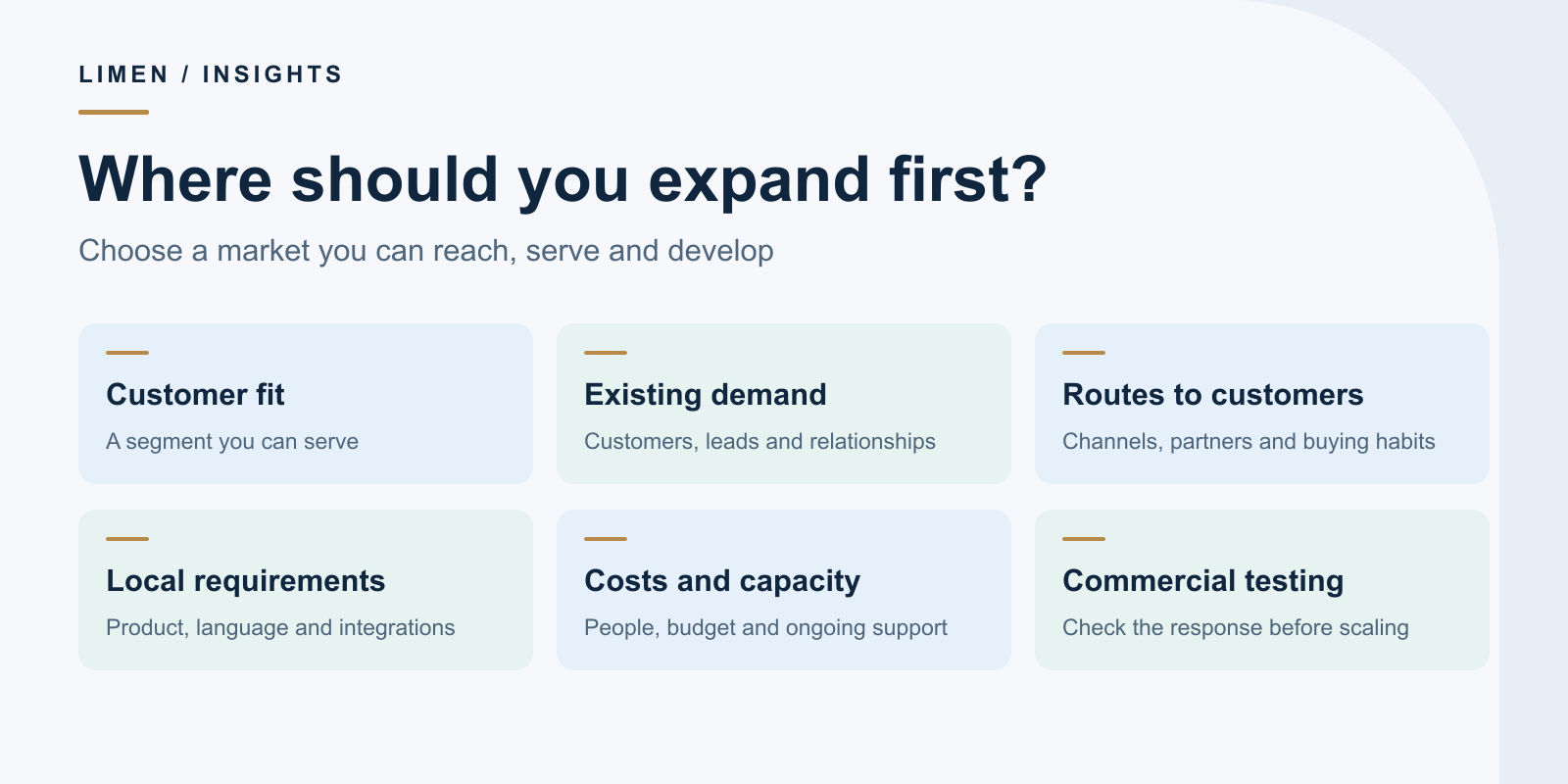
Start that analysis with your expansion goals, target customers, product and available resources. Review the foreign customers, enquiries and partner relationships you already have, then compare potential markets using criteria and weights that reflect your business. This gives you a basis for narrowing the options before investing in detailed country research. Existing demand is one factor in that comparison; it should be assessed alongside the opportunity, competition and your ability to acquire and serve customers.
Which European markets are worth considering?
You need a reason to include a country in the initial comparison. That reason could be a concentration of suitable customers, demand you are already seeing or a partner who can give you access to the right buyers. Geographic proximity helps with practicalities, but you also need to understand the competition. If buyers already have strong alternatives and your software offers little advantage, a large or nearby market may still be a poor place to start.
Belgium is worth exploring when you can identify customers similar to those you already serve and a realistic way to reach them. Existing relationships or a Dutch-speaking target segment may make the initial work easier. But define the segment and region you intend to serve, rather than assume that the whole country will respond to your Dutch offer in the same way.
Germany deserves attention if it has enough companies in your target segment and the opportunity justifies the work required to win them. If your current enquiries are German, or your team already has relevant language skills and industry contacts, you start from a different position than a company that needs to build those capabilities. Assess the competitors serving those buyers and whether your product has a clear advantage, alongside the requirements you would need to meet. This helps you judge both your chances of winning customers and how much of the Dutch approach you can reuse.
The UK can be a practical candidate for software already sold and supported in English, particularly where you have relevant customers or partners. However, language is only one part of the decision. You still need to understand competitors, acquisition channels, buyer requirements and any UK-specific conditions relevant to your product and operating model.
France belongs on the shortlist when there is a clear customer segment you can serve and a credible commercial route. Assess what the product, sales materials, contracts, onboarding and support need to look like for those customers. The cost of meeting those requirements should be compared with the opportunity, rather than treating localisation as a reason to dismiss the market automatically.
Sweden, Denmark and Finland are worth researching for cloud-based products, but each needs its own customer and competitor assessment. A high level of digital adoption can mean that buyers are familiar with buying software online. It can also mean that they already have established tools you would need to replace. Start with a specific country and segment, rather than budget for entering “the Nordics” as one market.
These are candidates to compare, rather than a fixed sequence. Strong demand in Spain, Italy, Poland or another country should also be investigated. And if your strongest opportunity is in the US, entering Europe first should be a deliberate choice rather than a prerequisite you impose on the business.
What does the country data tell you?
Country statistics help you screen opportunities, but the measure needs to be relevant to your product. For cloud software, one useful marker is how many businesses already buy cloud services.
Eurostat's 2025 enterprise ICT survey shows the following differences. The figures cover enterprises with at least ten people working in them in the surveyed sectors; they are not a count of potential customers for your particular software.
| Market | Enterprises buying paid cloud services in 2025 |
|---|---|
| Finland | 79.2% |
| Sweden | 72.0% |
| Denmark | 68.9% |
| Netherlands, for comparison | 68.5% |
| Belgium | 61.6% |
| Germany | 53.9% |
| France | 40.4% |
For your decision, the next question is how many businesses match your customer profile and what they currently use. A high percentage in a smaller market can still leave you with fewer suitable buyers than a lower percentage in a larger one. And if your product replaces a spreadsheet or manual process, existing cloud use may matter less than the cost of the problem you solve.
For industry-specific software, go further: identify the relevant companies, their size, systems and buying responsibilities. General software spending or enterprise counts will not show whether your product can solve their problem at a price that makes the market worthwhile.
Which criteria should you use to compare the markets?
The same market can look very different depending on the sales model. A low-price, self-service product needs enough users at an affordable acquisition and support cost. A product sold through a lengthy enterprise process needs a realistic account list, access to decision-makers and the resources to develop those opportunities.
Our foreign-market prioritisation framework groups the criteria into market attractiveness, market fit and accessibility, and market clusters and gateway potential. For a Dutch software company, those groups translate into the following questions:
- Market attractiveness. How large is your target segment, is demand growing, and what revenue and profit could you realistically generate?
- Market fit and accessibility. Can your software compete with the alternatives, meet local requirements and reach customers through channels your team or partners can operate?
- Market clusters and gateway potential. Would entering this country help you reach customers in neighbouring markets through shared relationships, channels or product requirements?
Use your own data and market research to assess these criteria, including the demand you already see in each country.
| Criterion | What to establish before choosing |
|---|---|
| Existing demand | Which countries produce relevant enquiries, trials, paying customers or requests from your current customers' foreign teams? Distinguish willingness to pay from interest. |
| Size of your target segment | How many companies match your industry, size, use case and budget requirements? Can you identify the actual buyers? |
| Growth and profitability | Is demand in that segment growing, what are customers willing to pay, and what margin could remain after acquiring and serving them? |
| Competition and alternatives | What do those customers use today, including manual work or in-house software, and why would they switch? |
| Sales channels and buying culture | Can you reach buyers through your existing channels? Who influences the decision, what evidence do they need, and how are introductions and supplier relationships established? |
| Product and language fit | Which integrations, workflows, languages and onboarding or support capabilities do customers need before they can use the software? |
| Legal and commercial requirements | Which product, data, contracting, tax or employment questions could change whether and how you can operate? Resolve consequential uncertainties with relevant specialists. |
| Cost and delivery capacity | What must you spend on acquisition, localisation, implementation, people and ongoing support? Can you fund the work while customers move through their buying process? |
| Gateway potential | Would customer relationships, partners or product localisation developed here help you enter another market? What additional work would still be required? |
What we usually recommend is to define the importance of these criteria for your company before scoring the markets. For an English-language product bought online, acquisition economics and support requirements may carry more weight. For software used in a regulated workflow, product requirements and the ability to satisfy procurement may determine which markets are feasible at all.
Your entry route also changes the comparison. A capable implementation partner can make a market accessible in a way that direct selling cannot, but you need to check its customers, incentives and willingness to develop your product. Compare the actual route available to your company, including your responsibilities and the partner's margin.
What can we learn from Dutch software companies' market choices?
Dutch companies have developed foreign business through different combinations of customer demand, local teams and partners. The relevant lesson is what made a particular opportunity workable, and what the company had to do to develop it.
Sendcloud: a partner created an opening in Belgium
Sendcloud's own timeline places its Belgian launch in 2014–2015, alongside its initial exploration of Germany. The Belgian opportunity developed when bpost approached Sendcloud at a trade fair about using its shipping solution. It had a concrete commercial opening to investigate, rather than only a belief that the neighbouring country should be easy to enter.
But its initial German approach ran into difficulties. The company took its Dutch solution into a market it did not understand well enough and subsequently changed its preparation, including research into local webshop systems, carriers and delivery expectations. For shipping software, those requirements affect whether the product is useful to the customer. A nearby country and a familiar problem did not remove that work.
Channable: different markets called for different capabilities and entry routes
Channable built its product and Dutch business for around two years before expanding into Germany with its first two German employees. The larger market was an attraction, while the German co-founder and local-language team gave the company capabilities it could use. It contacted agencies and researched the local channels and marketplaces its software needed to support.
The DACH region later became Channable's second-largest market, according to its German subsidiary announcement. Its experience gives a more useful basis for comparison than “Germany is big”: is there a customer segment you can reach, does your product support the channels those customers use, and can your team sell and serve them?
But Channable took a different route for its later Nordic expansion, when it announced the acquisition of Danish feed-management company WakeupData in June 2024. The acquisition brought an Aarhus team, local expertise and existing customer relationships into its Nordic expansion.
By that point, Channable already had an international business. Its Nordic expansion shows why the choice of market and entry route should be considered together. If a country looks promising but you lack customer access or local delivery capabilities, assess whether those gaps can be addressed through a suitable partner, a hire or, for a business with the resources, an acquisition.
Mollie: the UK opportunity involved more than selling in English
Mollie launched in the UK in early 2021, offering payments to domestic merchants and businesses expanding internationally. Its offer included access to European payment methods and a local support team. This gave it a specific proposition for the customers it wanted to reach.
By September 2024, Mollie reported triple-digit year-on-year UK growth in the first quarter of that year and an increase in its UK team from 16 to 26 people since 2023. The company had also announced its UK Payment Institution licence in November 2023. This was a later expansion by an established payments business, rather than its first foreign market. For a founder considering the UK, it shows why the proposition, local capabilities and applicable requirements belong in the decision alongside language.
You can read more about the broader lessons from these companies in this article on Dutch B2B international expansion.
How do you choose your own first market?
The country examples help you identify what to investigate. To make the decision for your company, follow the same prioritisation process: define the selection criteria, set their weights, score and shortlist markets, then review the findings and agree the priorities internally.
1. Define the selection criteria for your business
Start with your expansion goals and target customer profile, then choose criteria from the three groups above. Define what each criterion means for your product. Market size, for example, should reflect the number of companies you can realistically serve, while competition should include the tools, in-house software or manual processes those companies would need to replace.
Review leads, trial accounts, enquiries, existing customers and partner conversations by country. Ask your Dutch customers whether they have foreign teams with the same problem and whether you can speak with the relevant buyer. Use this evidence to assess demand in candidate markets, alongside countries with strong segment fit which your current marketing may not yet reach.
Also identify requirements that would make a market unworkable for now. If buyers need an integration you cannot build within the available budget, a high market-size score should not compensate for that problem. Record what would need to change before the country becomes feasible.
2. Define the weights and priorities for your company
Not every criterion should have the same importance. A low-price, self-service product needs an affordable way to acquire and support enough users. Enterprise software may depend more on access to decision-makers, local implementation and the ability to support a lengthy buying process. Give the criteria weights that reflect your company's goals, business model and resources.
For example, imagine a Dutch supplier of workflow software comparing Germany and Belgium. Germany produces more enquiries, but those buyers require an integration the product does not yet have. The Belgian segment is smaller but already uses a supported system, and a relevant partner is willing to help with the initial sales test. If the company cannot fund the German integration now, Belgium may be the more practical first test. If that integration is already planned and the German enquiries come from buyers prepared to pay, the decision could change.
3. Research, score and shortlist the markets
Start with a broad list of plausible markets and compare them using the same criteria and weights. Research your target segment, growth, willingness to pay, competition, entry requirements and costs. Score each market on a consistent scale, with a higher score representing a more favourable position for your company, then apply the weights to compare the results.
Use the initial comparison to narrow the list and investigate the strongest candidates in more detail. Check important gaps with potential customers, partners and relevant specialists. Keep unresolved assumptions visible, so the team can distinguish a promising estimate from a confirmed requirement. The scores should help you discuss the options; they do not replace the decision.
4. Validate the shortlist and agree where to focus
Review the shortlisted markets with your team, discuss the evidence and agree which opportunity best fits your goals and capabilities. Challenge the ranking where it depends on uncertain assumptions, and confirm that the company can fund and deliver the proposed approach.
For an initial expansion, we recommend selecting one primary market rather than dividing the team's commercial effort across several launches. Keep another shortlisted market as a backup if the first does not prove viable. This gives you an alternative to reconsider without committing to two operations from the start.
Agree who will own the work, the resources available and when you will review progress. If the first market disappoints, examine whether the problem is the market choice or an approach that needs to change before switching countries. Reassess the backup against what you have learned before committing to it.
After prioritisation, develop and test the entry approach
Once you have selected the primary market, develop the go-to-market strategy: define the target segment, offer, positioning, pricing, sales channels and operating model. Then test the commercial assumptions before increasing investment.
Define the customer segment, offer, price and sales channel you intend to test. Agree what would count as a useful result, when you will review it and how much time and money you can commit. For self-service software, examine paid conversion, acquisition cost and the support needed. For enterprise software, examine access to the right buyers, progress through procurement, pilots and willingness to commit to a purchase.
Use the results to decide whether the market remains the right priority, whether the approach needs to change or whether another country deserves the resources. You can read more about organising these tests in this article on market-demand validation.
Choose the market you can develop into a business
Your first market should give you a realistic way to acquire customers and build a business you can sustain. That may be a neighbouring market, an English-language market or a country where your industry relationships and product fit give you a better starting point.
At LIMEN, our market intelligence and prioritisation work helps companies compare these opportunities against their own customers, capabilities and resources. We can help you research the shortlist and define what needs to be tested before committing to a larger expansion.
If you would like to discuss which markets make sense for your software business, book a free 30-minute consultation.