TL;DR
- Market demand validation tests customer demand, willingness to pay and the channels you plan to use before you commit to a full launch.
- There are three approaches to validating demand: acquire the first paying customers, pre-sell or test demand without fulfilling orders, or run a market test through a partner or distributor.
- The approach you choose should fit your business model and the investment needed to test it. Before starting, define what results would justify moving forward.
- Based on the results, you can decide whether to proceed, adjust, pause or stop, taking into account demand, conversion and the cost of acquiring customers.
Companies often develop a strategy for a new market and then move directly into a full launch. But no matter how much analysis they have done, they can still miss something important or misunderstand how the market works in practice.
For example, you might have a great product and expect to sell it successfully in a new country. But once you start, you may discover that the market is highly relationship-driven and that, without somebody local who already has the right connections, it is very difficult to generate any sales.
That is why we usually recommend starting with a relatively small market test. The idea is to validate the assumptions behind your strategy and check whether there is actual demand before committing substantial resources. This is the fourth stage in our six-step framework for entering foreign markets.
Such a market test can cost just a few thousand dollars and potentially save you hundreds of thousands that you could otherwise commit to a market that does not work for your business.
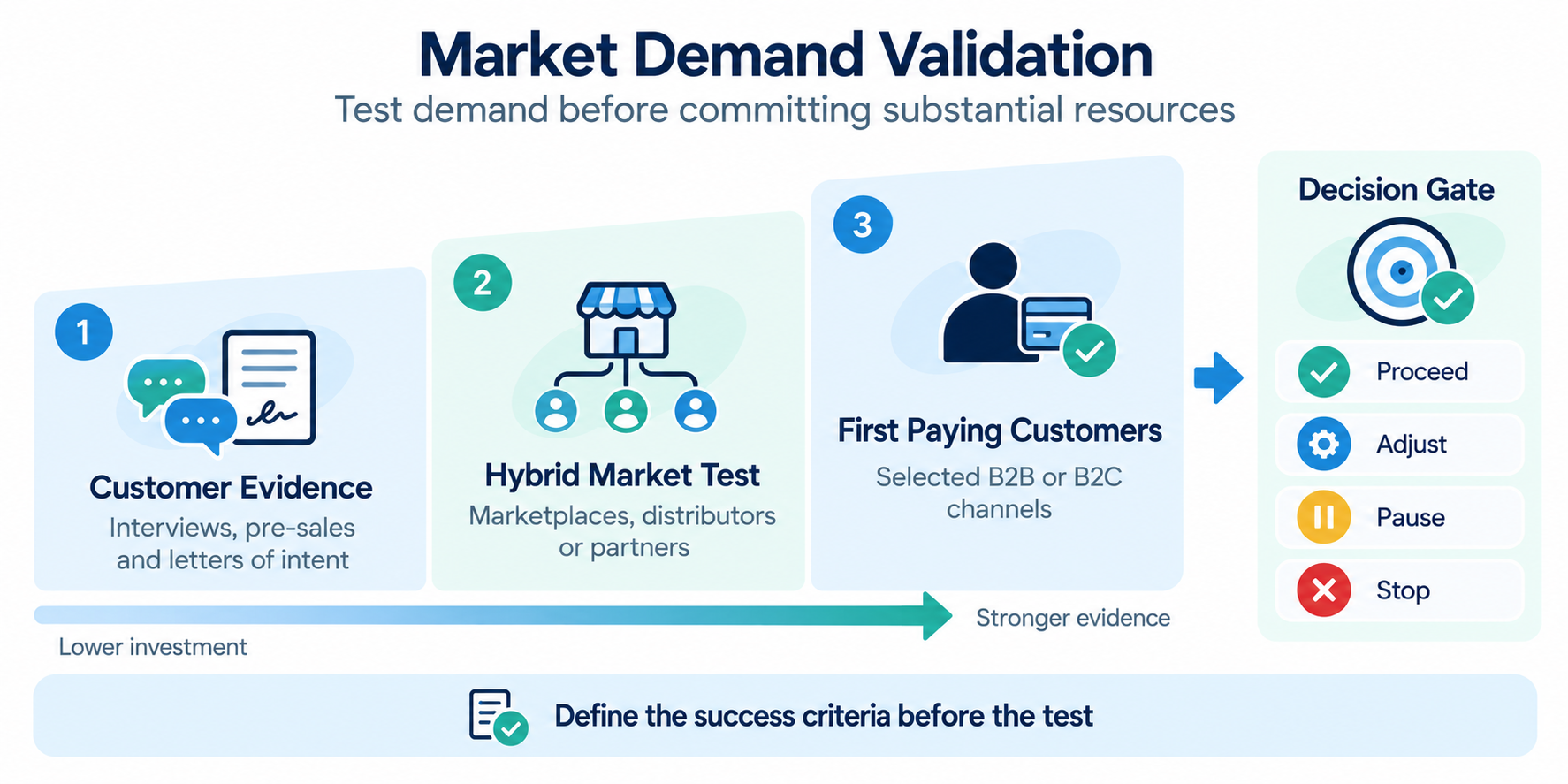
The strength of the evidence should increase before the company commits more resources.
The way you validate demand can differ significantly by industry and business model.
Approach 1: Acquire the first paying customers
For some businesses, particularly SaaS or other products that are relatively easy to sell and deliver across borders, the strongest market validation is to acquire the first paying customers.
Choose one or several marketing and sales channels that allow you to reach potential customers relatively quickly.
-
B2C companies. Paid advertising through channels such as Google or Meta can be used to bring traffic to a website and test whether those visitors convert into sales.
-
B2B companies. Cold or warm outreach, industry events and conferences are common ways to reach potential customers and try to close the first deals.
For example, for one client we created a list of relevant contacts and conducted direct outreach. This generated several customer calls and eventually the first deals, allowing the company to test whether its product fitted the needs of customers in the new market.
Approach 2: Pre-sell or test demand without fulfilling orders
Things can become more complicated when your business involves physical goods, manufacturing, or local infrastructure. If your eventual market entry requires a production facility, you probably do not want to build one just to test whether people are interested in buying your product.
There are several alternatives you can consider.
-
Speak with potential customers. You can start by interviewing customers and understanding whether your product resonates with them and whether they would consider buying it. This is not the most reliable proof of demand, but it is still better than investing heavily without testing anything.
-
Pre-sell or sign letters of intent. Startups often do this before their product is fully developed. A prospective customer’s willingness to make a preliminary commitment can be a useful signal, although a letter of intent is not necessarily the same as a completed sale.
These approaches require less investment, but they also provide weaker evidence than actual sales. People can express interest without being willing to pay when the product becomes available.
Approach 3: Test demand through a partner or distributor
There are also intermediate ways to validate demand before building your own full operation. A company can first speak with a small number of customers, partners and other market participants. It can then set up a limited experiment using selected channels such as marketplaces, distributors or other partners.
This goes further than customer interviews or letters of intent because the company puts a real offer in front of the market. At the same time, it does not require the investment needed to build a complete local sales and operational setup.
In practice, we used this approach for one fashion brand. We first spoke with other brands that had recently launched in the market to understand whether the entry was still feasible and what challenges they had faced.
Then, instead of investing immediately in our own direct-to-consumer setup, we selected one B2B channel and one B2C channel to test demand: a marketplace on the B2B side and a distributor on the B2C side. This allowed us to validate the initial demand before investing in our own direct-to-consumer presence. This kind of phased validation is often a practical option for physical-product businesses.
How to define success criteria before you start testing
It is important to define the validation criteria before you run the test. What results would be strong enough for you to move forward?
This could be a certain number of qualified customer conversations, a target conversion rate, a minimum number of first customers, a distributor commitment, or a maximum acceptable acquisition cost.
The right criteria depend on the business model. For one of our B2B clients with a high average contract value, we set the goal of signing at least two customers before establishing any local presence. Two signed deals would already cover the initial costs of entry and confirm that the team could close in the new market without a local hire or office. For B2C companies with a low average order value, the test is more typically focused on conversion rates and the unit economics of customer acquisition through the paid channels most commonly used in the industry.
If you do not define the criteria in advance, it becomes much easier to interpret weak results too optimistically and continue investing in a market that has not really validated your assumptions.
The key is to ask two relatively simple questions:
- What are the critical assumptions we need to test to be confident that the strategy can work?
- What is the easiest sufficiently reliable way to test them?
How long does market demand validation take?
In our experience, a structured market test typically takes two to three months. That is usually enough time to run outreach, hold conversations with potential customers, close or nearly close the first deals, and draw a meaningful conclusion.
The main factors that extend timelines are deal cycle length, the time needed to build the right contact list, and the choice of channels. For one of our clients, the average deal cycle was around six months, which meant the validation naturally took longer — not because the test was inconclusive, but because that is simply how long it takes to reach a buying decision in that industry. A company relying on inbound leads from paid advertising will typically see results faster than one doing outbound into a market where it has no existing network.
The goal is not to run the test as long as possible, but to gather enough evidence to make a decision.
How to decide whether to proceed, adjust, or stop
The purpose of validation is to support an actual decision. By the end of the test, you should be able to decide whether to proceed with the strategy, adjust it, pause the entry until certain conditions change, or stop investing in the market.
After conducting market validations for dozens of businesses, we cannot emphasise enough the importance of this step. In many cases, the initial assumptions are not confirmed and the plan needs to be adjusted.
Ideally, by the end of this stage, you will have tested your main assumptions, obtained real market feedback, and secured your first customers, orders, or letters of intent. You can then decide whether the strategy is ready for broader implementation.
The next stage is to execute the market-entry strategy, track the results and adapt it based on the evidence.
If you want to test demand before committing significant capital, see how our Demand Validation Sprint works or book a free 30-minute consultation.