TL;DR
- Foreign market prioritisation helps you decide where to expand first by comparing potential markets against your business goals, product, capabilities and resources.
- To prioritise markets, you should assess market attractiveness, fit for your business and accessibility, and whether a country could support further expansion into neighbouring markets.
- Define the weight of each criterion based on its importance to your company, then score the markets and use the results to develop a shortlist.
- Review the shortlist with your team and agree which markets to explore further; an attractive market in general may still be a poor choice for your business.
When planning an international expansion, one of the first major decisions is which foreign markets to enter. A market can look attractive in general but still be a poor choice for your particular company.
This is an important decision. If you enter a declining market or one without your target audience, your experience and results are likely to be very different from entering a growing market with strong demand for your particular product.
Despite that, companies often make this decision based on personal preferences or anecdotal recommendations. Somebody tells them that a certain country looks interesting, or a founder simply wants to work in a specific market because they like the country. That is not necessarily the most rational way to approach market selection.
Foreign market prioritisation gives you a more structured way to compare the options. It is the second stage in our six-step framework for entering foreign markets.
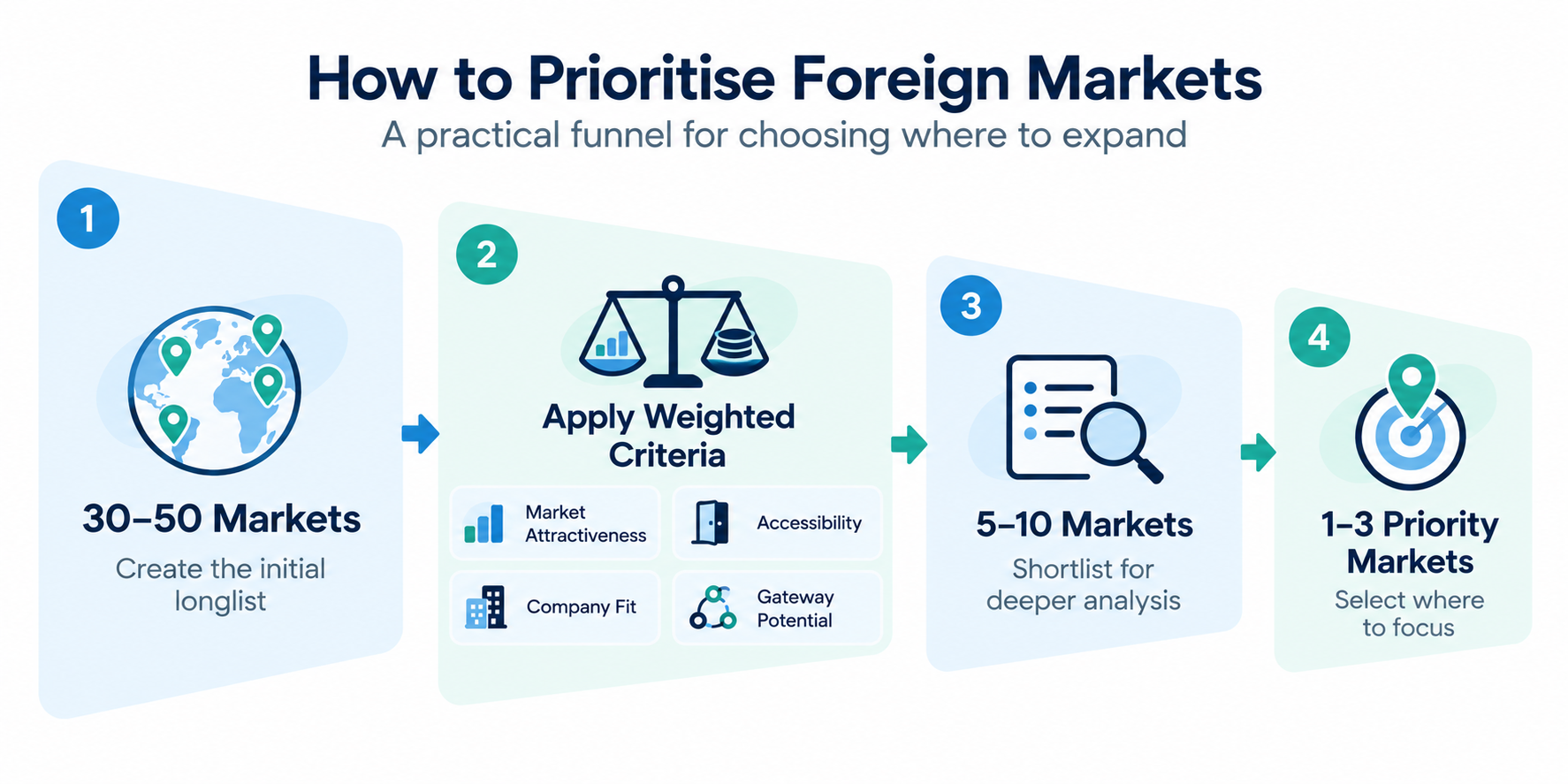
A practical funnel for choosing which foreign markets to enter.
Define the selection criteria
Start by defining the criteria you are going to use to evaluate potential markets. Some criteria are relatively standard, while others should be specific to your business, industry and expansion goals. The criteria can be divided into several groups.
Market attractiveness
-
Market size. First, look at the overall size of the market. Is it large enough to justify the investment required to enter it?
-
Growth rate. Then look at whether the market is expanding, stable or declining. A smaller but rapidly growing market can sometimes be more attractive than a larger market with limited growth.
-
Profitability. You could also consider profitability and willingness to pay, as they contribute to the overall profit you can expect. For some companies, overall profitability might be more important than the total revenue potential.
-
Market size in your specific segment. You can then go one level deeper and estimate your addressable market. Unless you are targeting the entire market, its overall size does not tell you how much opportunity there actually is for your company. Define your target audience and try to understand how large that specific segment is.
Market fit and accessibility
-
Competition. Next, look at the competition. A market might be large but already have strong, well-established competitors. Another might be smaller but growing, with less competition. If you do not yet have a strong brand or a product with clear advantages over competitors, you might want to avoid making an extremely competitive market your first international expansion.
-
Barriers to entry. Then assess the barriers to entry. These could include legal requirements, customers being locked in with existing competitors, or cultural barriers. In some countries or industries, for example, you may need a local presence and business development in the local language to sell successfully.
-
Entry complexity. Evaluate how difficult the market would be to enter and what resources and management attention would be required. This may include legal setup, product adaptation, recruitment, marketing, sales and local operations.
-
Company fit. Assess how well the market fits your product, brand, capabilities and available resources. A market might be attractive in general but still be a poor fit for your particular company. For example, one of our clients had a women’s fashion brand in Europe. The Middle Eastern markets we assessed were not a good fit because customer tastes were significantly different and entering them would have required developing an almost completely new clothing line.
Market clusters and gateway potential
It is also useful to look at markets through the lens of regional clusters. Some countries can open the door to neighbouring markets because they share customers, languages, regulations, distribution networks or business relationships.
For example, entering one market might make it easier to expand into several other countries in the same region. Another market might be attractive on its own but offer few opportunities for further regional growth. This gateway potential should be considered as part of the longer-term expansion strategy.
Define the weights and priorities for your company
Not every criterion should have the same importance. The weights need to be defined specifically for each company because they depend on its priorities, product and resources.
A company focused on short-term profitability may give more weight to willingness to pay, entry complexity and speed to market. A company building a long-term global position may put more weight on market size, growth and gateway potential. The purpose of the weighting is not to create a universally correct ranking. It is to make the ranking reflect what matters most to your company.
The same market can therefore be a strong priority for one company and a poor choice for another.
For example, a company with a top-quality product that is already competitive in the United States may decide to enter the US because it is large and profitable, even though it is also highly competitive. Another company without the same competitive advantage or resources may have a better chance of success by starting with a smaller and less competitive market.
India is another useful example. It can offer significant market volume, but prices in some sectors can be much lower than in the United States or Western Europe. This works for some companies but not for others. Some businesses may decide not to sell there at all, while others may use India as a hub to provide services or produce goods that are then sold in higher-priced markets.
These considerations can all be reflected in the selection criteria and their weights.
Score and shortlist the markets
Once you have defined the criteria and their weights, you can research and score the markets that make sense to consider. You will then be able to compare them in a more structured way rather than relying only on personal opinions.
We usually start with a broad range of markets, often 30–50, and then narrow the initial selection down to around 5–10 markets, sometimes even 3–5, before conducting a deeper analysis of the remaining options.
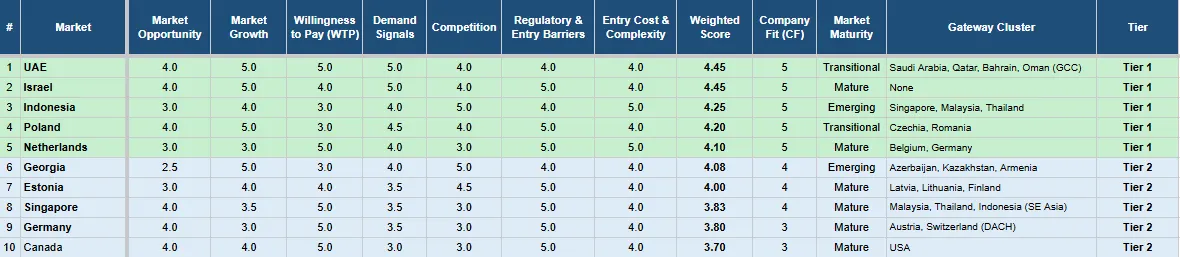
An example of a weighted market-prioritisation scorecard.
View the scorecard as a text table
| Rank | Market | Market Opportunity | Market Growth | Willingness to Pay (WTP) | Demand Signals | Competition | Regulatory & Entry Barriers | Entry Cost & Complexity | Weighted Score | Company Fit (CF) | Market Maturity | Gateway Cluster | Tier |
|---|---|---|---|---|---|---|---|---|---|---|---|---|---|
| 1 | UAE | 4.0 | 5.0 | 5.0 | 5.0 | 4.0 | 4.0 | 4.0 | 4.45 | 5 | Transitional | Saudi Arabia, Qatar, Bahrain, Oman (GCC) | Tier 1 |
| 2 | Israel | 4.0 | 5.0 | 4.0 | 5.0 | 4.0 | 5.0 | 4.0 | 4.45 | 5 | Mature | None | Tier 1 |
| 3 | Indonesia | 3.0 | 4.0 | 3.0 | 4.0 | 5.0 | 4.0 | 5.0 | 4.25 | 5 | Emerging | Singapore, Malaysia, Thailand | Tier 1 |
| 4 | Poland | 4.0 | 5.0 | 3.0 | 5.0 | 4.0 | 5.0 | 4.0 | 4.20 | 5 | Transitional | Czechia, Romania | Tier 1 |
| 5 | Netherlands | 3.0 | 3.0 | 5.0 | 4.0 | 3.0 | 5.0 | 5.0 | 4.10 | 5 | Mature | Belgium, Germany | Tier 1 |
| 6 | Georgia | 2.5 | 5.0 | 3.0 | 4.0 | 5.0 | 4.0 | 4.0 | 4.08 | 4 | Emerging | Azerbaijan, Kazakhstan, Armenia | Tier 2 |
| 7 | Estonia | 3.0 | 4.0 | 4.0 | 3.5 | 4.5 | 5.0 | 4.0 | 4.00 | 4 | Mature | Latvia, Lithuania, Finland | Tier 2 |
| 8 | Singapore | 4.0 | 3.5 | 5.0 | 3.5 | 3.0 | 5.0 | 4.0 | 3.83 | 4 | Mature | Malaysia, Thailand, Indonesia (SE Asia) | Tier 2 |
| 9 | Germany | 4.0 | 3.0 | 5.0 | 3.5 | 3.0 | 5.0 | 4.0 | 3.80 | 3 | Mature | Austria, Switzerland (DACH) | Tier 2 |
| 10 | Canada | 4.0 | 4.0 | 5.0 | 3.0 | 3.0 | 5.0 | 4.0 | 3.70 | 3 | Mature | USA | Tier 2 |
The scoring does not make the decision automatically. It helps make the assumptions visible and gives the team a shared basis for discussing the options.
Validate the shortlist and align internally
With a shortlist of 5–10 markets and a better understanding of those markets, you can organise an internal strategy session within your company. Present the findings, explain the rationale behind the proposed priorities, and discuss the options with the team. The final outcome should be an agreed selection of the market or markets you want to enter.
Choosing only one market as your initial priority can be entirely sensible, especially when your resources are limited. However, you might also want to keep 2–3 markets at this stage and deep dive into them while developing the go-to-market strategy.
In practice, this kind of structured prioritisation can save a company from investing in the wrong market simply because it looked attractive at first glance.
Once the priority markets have been selected, the next step is to define how you are going to enter them.
If your company needs help comparing and prioritising international markets, see our market intelligence and prioritisation support or book a free 30-minute consultation.