TL;DR
- Start by defining your goal for expanding into the Netherlands: to get Dutch customers, test your product in the market or establish a base for a wider European business.
- Assess whether the Netherlands is a good fit for your target segment by looking at customer needs, buying behaviour, decision-making processes, channels and support expectations.
- For software aimed at international teams, English may be enough for an initial test, while Dutch can help you reach locally oriented businesses and traditional industries. Your communication should also reflect the direct Dutch business culture.
- Your entry strategy should define the offer, channels and operations, including local requirements such as payment methods. Then test customer demand, acquisition costs and the work required to serve customers before increasing investment.
The Netherlands can be an attractive market for international expansion. It has a digitally advanced economy, an international business environment and connections to other European markets. But to understand whether it is a good choice for your business, you need to look at the customers you want to reach, what they need and how you can realistically compete here.
At LIMEN, we are based in the Netherlands and help companies understand the local market, develop their entry strategy and test demand.
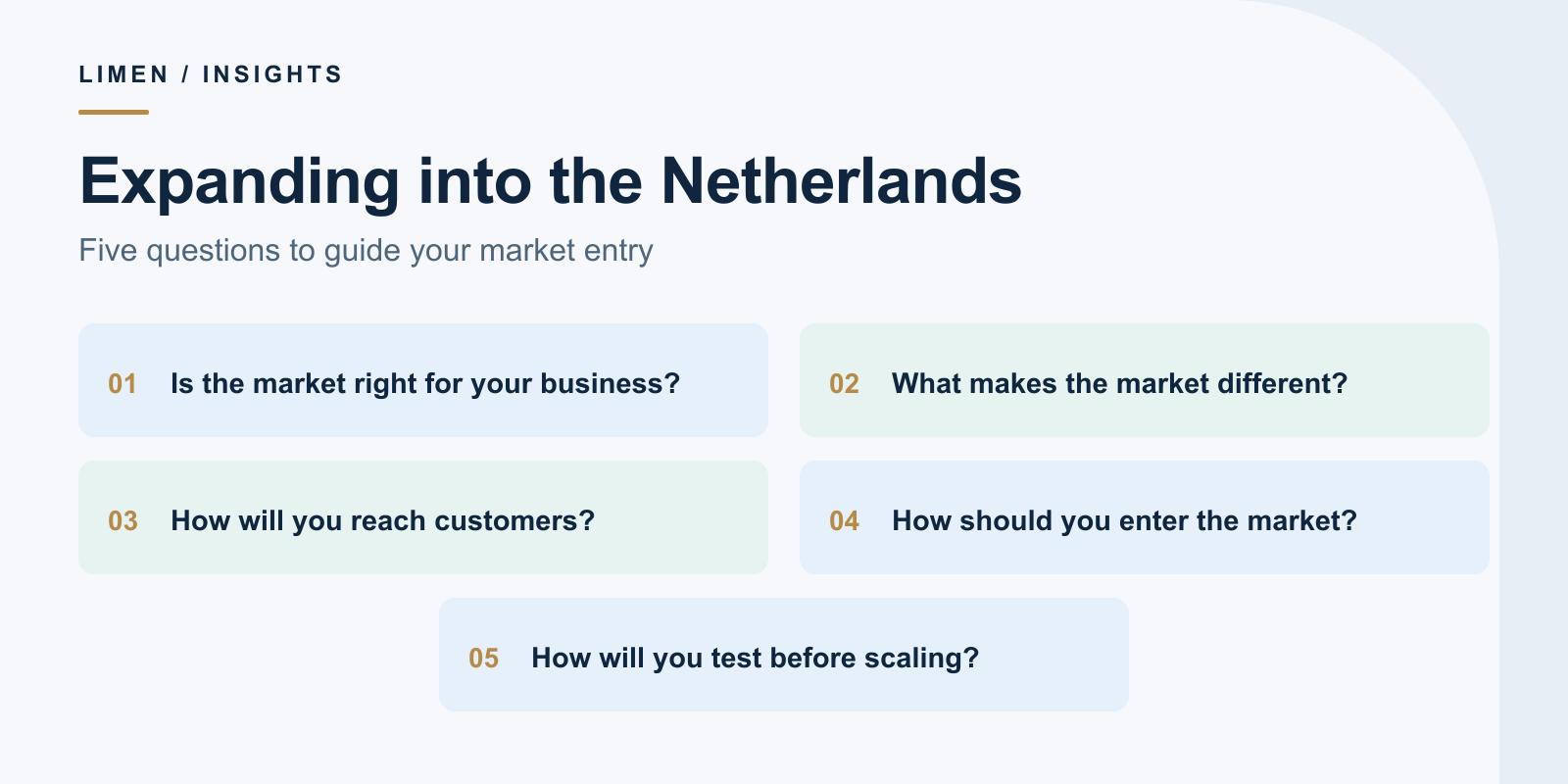
There are several questions to answer when considering expanding your business into the Netherlands:
- Is the Netherlands a good fit for my product and target customers?
- Can I start in English, or do I need to adapt my offer and communication to Dutch?
- Which channels should I use to find customers and partners?
- Should I serve the market from abroad, build a local team or establish a regional base?
- How can I test the opportunity before making a larger investment?
The answers will be different for a software company, a consumer brand and a business choosing a European headquarters. In this article, we look at where the Netherlands may offer a good opportunity, what is specific about the market and how to develop an entry approach for your company.
1. When is the Netherlands a good fit for your business?
Start by defining what you want to achieve in the Netherlands. You may be looking for Dutch customers, a market in which to test your product, or a base from which to manage a wider European business. These goals influence which opportunities matter and what preparation you need.
Digital products and services
The Netherlands is worth considering if your business serves customers who are comfortable buying and working online. In 2025, around 80% of Dutch residents aged 12 and over had bought something online in the previous three months. This creates a relevant environment for online services, e-commerce and products which help companies improve their digital operations.
The opportunity still needs to be assessed at the level of your target customer. A company may already use several software products, while a consumer may have established preferences for particular shops or brands. You need to understand which problem your offer solves better and why the customer would choose it over the alternatives.
Businesses serving startups and growth companies
The Netherlands has an established startup and scaleup ecosystem, including companies in AI and deep technology. If your business provides software, specialist services or support for growing companies, this can give you relevant communities in which to find customers and partners.
Be specific about which companies you want to reach. An early startup and an established scaleup can have very different budgets, priorities and purchasing processes. Researching these differences will help you decide whether there is a sufficiently valuable segment for your business.
Consumer brands and physical products
There may also be an opportunity for consumer products which fit local preferences and can be delivered competitively. The online-shopping market gives foreign brands a route to customers, while retailers and distributors can provide access for products which depend on physical availability, advice or local service.
For these businesses, market fit includes the cost of getting the product to the customer and supporting it afterwards. A product can attract interest but still require changes to its range, pricing, packaging or distribution before the expansion makes financial sense.
A base for a wider European business
Some companies choose the Netherlands as a regional headquarters or operating base. Depending on their business, this can support activities across Benelux, Northern Europe or the German-speaking markets of Germany, Austria and Switzerland. Transport connections, access to international talent and the ability to coordinate regional teams are relevant factors in this decision.
Netflix and Uber have their EMEA headquarters in Amsterdam, while Nike has its European headquarters in Hilversum. These companies illustrate how a Dutch base can serve a business whose activities extend well beyond the domestic market.
For your company, the question is which functions would benefit from being here: management, recruitment, sales coordination, customer support or logistics. You should also assess the customer opportunity in each country you intend to serve. Establishing a base in the Netherlands does not remove the need to understand how those other markets work.
Before choosing the country, compare the opportunity with your goals and resources. If you need a much larger domestic customer base, or the required local service would be too expensive to provide, another market may be a better starting point. You can read more about making this comparison in this article on choosing foreign markets.
2. What should you understand about the local market?
Once you have identified a potential opportunity, look at how your customers buy, communicate and expect to be served. This is where some of the Netherlands' apparent advantages need to be translated into decisions about your own offer.
English can help you start; Dutch can help you reach further
English is widely spoken in the Netherlands, which can make initial conversations and market research easier. If you sell software to international teams, you may be able to test the market with an English product, website and sales process, then decide where localisation is needed as you learn more about your customers.
But this will not work equally well for every segment. In our experience, using Dutch can bring a much better response in more traditional industries, even when people are able to communicate in English. For a consumer business, you should also consider the language customers expect when comparing products, asking for help or dealing with a return.
It is useful to assess each part of the customer experience separately. HubSpot, for example, offers its software and knowledge base in Dutch, but not for onboarding and support. Localisation can therefore involve different choices for the product, commercial materials and service, rather than translating everything at the same time.
Dutch culture values directness
The Dutch are known for being very direct, and this is reflected in how they do business. Reliability, punctuality and preparation are valued as well.
In practice, direct feedback can make doing business easier because you can discuss objections openly. If a potential customer questions the price or says that a feature is missing, use the conversation to understand what would need to change for the offer to become relevant. Ask clear questions and make it easy for the person to give an honest answer.
Dutch customers generally expect you to be direct about your proposal and conditions as well. Explain what you will deliver, what it costs, what the customer needs to do and what happens next. Follow through on agreed actions and timings, as this is part of building trust with a new supplier.
Customers research products through digital channels
You can expect many potential customers to look for information about your company and products online before making a decision. It is therefore important to establish a good presence in the digital channels they use, with clear information about your offer, your company and how to buy or contact you.
For your target segment, check where this research happens: search engines, social media, marketplaces, review sites or industry platforms. Make sure customers can find relevant information there and that it is consistent with what you communicate through your website and sales team.
3. Which channels can help you find customers?
The main channels are broadly similar to those in other established markets: search, social media, direct outreach, partners and events. There are, however, local specificities to consider, including language, the platforms your customers use and the role of local relationships.
Targeted outreach and relevant introductions
If you sell to businesses, direct conversations can help you understand the market and find your first customers. Relevant introductions through customers, partners and professional communities can be useful, particularly when the offer needs explanation or trust in the supplier matters.
LinkedIn may also be part of this approach, but in our experience getting responses through outreach has become more difficult. To give the recipient a reason to respond, tailor the message to the company's situation, needs and recent developments. A reference to an expansion, a new product or a change in the team should explain why your offer is relevant now.
For example, if a company has announced entry into another country, a message about a specific operational problem associated with that move is more useful than a general introduction to your services. You still need to establish whether the problem exists and whether the person is responsible for addressing it.
Using Dutch can also help when approaching locally oriented businesses, particularly in more traditional industries. Consider both the relevance of the message and the language in which the customer is most comfortable discussing it.
When planning outreach, check the Dutch rules on unsolicited commercial messages. Do not assume that contacting a business makes every form of unsolicited outreach permissible.
Local partners, content and demonstrations
A local partner can help when customers need advice, implementation or ongoing service alongside the product. To make that relationship work, you need to understand which customers the partner serves, why it would recommend your offer and what support it needs from you.
HubSpot's Dutch partner One4Marketing, established in 2011, built a business helping Dutch technology companies adopt inbound marketing. It used educational content and practical demonstrations to show customers how the approach could work for them. The agency also provided implementation services around HubSpot's software.
For a foreign supplier, this illustrates how a local partner can help customers understand and use an offer. If your product requires customers to change how they work, you may need a similar combination of explanation, proof and practical support to develop the market.
Consumer channels and social media
For consumer products, assess search, social media, creators, marketplaces and retail relationships against the way your customers shop. A product customers actively search for may need a different approach from one they first discover through a creator or see in a shop.
You will recognise many of the same social platforms used elsewhere, but check their relevance to your particular audience. According to Newcom's 2026 research, YouTube, Facebook, Instagram, LinkedIn and TikTok all have larger audiences than X in the Netherlands. Your channel choice should follow where relevant customers are active and how they respond to the offer.
For a marketplace or retail route, also assess the commercial terms, control over the customer experience and what remains of your margin after the channel's costs. Reaching customers through an established platform may be useful, provided the economics support it.
International events in the Netherlands
Events can help you meet both Dutch and international customers and partners. RAI Amsterdam, for example, has a busy calendar of national and international exhibitions and conferences across different industries. These events can support your research into the Dutch market while also helping you develop wider regional or international contacts.
Check who will attend and which conversations would be valuable before deciding to participate. Arrange meetings where possible, prepare questions about the market and define how you will follow up. This gives the event a clear role in your expansion work.
4. How should you develop your Netherlands market entry strategy?
Once you understand the opportunity and the local specifics, turn that research into decisions about your target customers, offer, channels and operations. What we usually recommend is to start with a clearly defined segment, so the team can prepare and test an approach for customers with similar needs.
Define the offer and the adaptations required
Compare your product with the alternatives available locally. Why would your target customers choose it? What would they need to change to use it, and what would you need to change to serve them?
Sometimes the adaptation concerns the product itself, such as differences in sizes, packaging or the range of products customers expect. A clothing brand, for example, may need to adjust its size range to suit local customers.
The way customers buy and use the product should also reflect local expectations. For an online shop, this includes payment methods such as iDEAL, which is transitioning to Wero, as well as delivery options and returns. For a software company, it may involve integrations, onboarding and support.
Include the cost and timing of these changes in the plan, and distinguish what customers need before they can buy from improvements which can follow as the business develops.
Choose how to enter and support the market
Your entry model needs to match the work required. Serving customers from your existing team may be practical if the product can be delivered remotely and support needs are manageable. A partner may make more sense when you need access to a customer network, implementation capacity or local distribution.
For your company, define who will handle sales, customer onboarding, delivery and support, and where those people need to be based. If the plan requires local recruitment, stock or premises, include the related investment and ongoing costs before committing to the model.
The legal structure should follow an assessment of the planned activities. Selling across borders, hiring employees and opening a local operation raise different questions; official foreign-company guidance explains that registration requirements depend on the situation. Establish what applies to your business alongside the commercial and operational planning.
At this point, you should have a clear view of whom you are targeting, what you are offering, how you will reach customers and what resources are needed to serve them. You can read more about connecting these decisions in this article on building a go-to-market strategy.
5. How can you test the market before scaling?
Even with good preparation, some assumptions will need to be tested through actual customer conversations and sales. Start with a manageable segment, an offer you can deliver and a channel you can operate consistently. Decide what you need to learn and which results would justify further investment.
For a business service, this might mean speaking with relevant decision-makers, testing a proposal and establishing whether customers will pay for an initial project. For a consumer product, a limited launch can help you assess acquisition costs, purchases, delivery costs and returns. Include the work required after the sale, as it affects whether the business can scale profitably.
The test should help you answer several questions:
- Are we reaching the customers we intended to target, and is the problem relevant to them?
- Do they understand our offer and have a clear reason to choose it?
- What needs to change in the product, language, price or sales approach?
- Can we acquire and serve these customers at a cost the business can support?
- What would we need to invest in people, partners or operations to grow?
Once you have this evidence, you can decide whether to continue with the approach, adjust it or prioritise another opportunity. A test may show that customers are interested but need more local support, or that the offer works for a different segment from the one you initially chose.
If you are considering the Netherlands as a regional headquarters, assess the operating location alongside this commercial work. A Dutch customer test will not answer whether you can win customers in Germany, Belgium or other markets you intend to serve from that base.
You can read more about planning a test and using the results to make an investment decision in this article on market demand validation.
Planning your expansion into the Netherlands
The Netherlands may offer an attractive opportunity if there is a clear fit between your business, the customers you want to reach and the role the country will play in your growth. Understanding local expectations helps you decide what to adapt, which channels to use and how to organise the operation. Testing that approach then gives you a stronger basis for deciding where to invest further.
LIMEN is based in the Netherlands and has a good understanding of the local market. We can help you assess whether it is a good fit for your business, research customers and channels, and develop and test your entry strategy. If you are considering expanding into the Netherlands, book a free 30-minute consultation to discuss your plans and the support you need.