TL;DR
- An international go-to-market strategy turns market research into clear decisions about how your company will enter and compete in a new market.
- To develop the strategy, you need to define your target customers, offer, channels, pricing, positioning, entry mode, approach to market barriers and business case.
- The choices about product localisation, partners and responsibilities should reflect local customer requirements and the capabilities your company already has.
- Once the approach is clear, align the team on it, turn it into an execution plan and validate demand before committing substantial resources.
Entering a new market requires more than good market research. The company also needs to make clear decisions about which customers to target, what to offer, how to reach them and how the business will operate.
The go-to-market strategy should connect what you have learned about the market with clear decisions about the customers, product, channels, pricing, positioning and operating model. It is the third stage in our six-step framework for entering foreign markets.
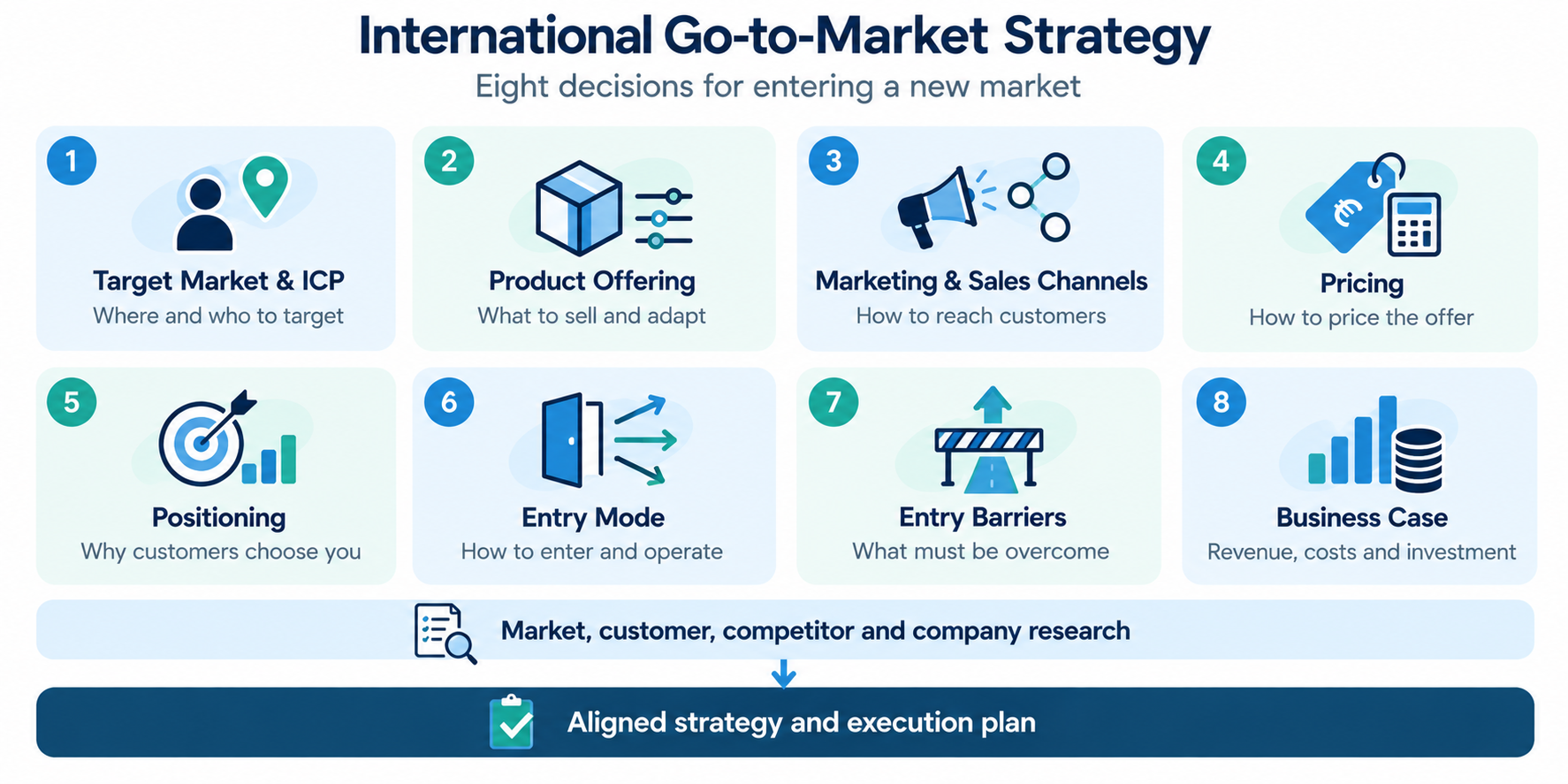
Eight decisions for entering a new market.
Research the target markets
Before making the strategic decisions, you need to understand the market, the customers, the competition and your own capabilities in more detail.
-
Understand the market landscape and segments. Start by reviewing the size and structure of the market. Assess not only how large the market is, but also what different segments exist within it. The goal is to understand what the market actually looks like and which segments might be the most interesting to target.
-
Research your customers. Once you have identified the key segments, analyse the customers within them. Who are they? What are their specific needs and preferences? You should also look at their buying behaviour and how they make purchasing decisions. Speaking directly with potential customers and other people in the market can be very useful alongside desk research. All this information will help you later define which customers you want to target and how exactly you can reach them.
-
Research your competition. Competition is actually one of the most valuable sources of market intelligence. Identify the key competitors, the segments they target, and the products they offer. You can benchmark their products against yours and study the marketing and sales channels they use. When looking at competitors, it is important to distinguish between what you can observe and what you can actually confirm about their results. Sometimes companies make a lot of noise and have strong PR, but their actual results are not good. Those companies are not necessarily the ones you want to learn from.
-
Analyse your company and its competitive advantages. The strategy should not be based only on the external market. You also need to understand what your company does well, where it is weaker, and which assets and capabilities could give you an advantage. These could include the product, technology, brand, customer relationships, operational capabilities, data, intellectual property or access to specific channels. This helps you identify where the company can realistically compete and where it may need additional capabilities or partners.
-
Understand the barriers to entry in detail. Explore the specific legal, regulatory, commercial, operational and cultural barriers that apply to your chosen market. More importantly, understand what you would need to do to overcome them. This will directly influence your entry strategy and the resources required to execute it.
For example, when we developed an international expansion strategy for a wood-processing company, we created a matrix covering markets, customer segments, competitors and the capabilities of the company. This helped us identify the most promising combinations of markets and segments to target. The company later signed its first international contracts worth several million euros.
Turn the research into strategic decisions
At this stage, you have collected quite a lot of information. But research alone is not yet a strategy. A good market research report can tell you what is happening in a market. A strategy goes one step further: it makes explicit choices about what you are going to do, where you are going to focus, what you are not going to do, and how you expect to win.
The main decisions you need to make are:
-
Target customers. Which geographical markets and customer segments are you going to prioritise? Who is your ideal customer profile within those segments, and which customers are you not going to target initially?
-
Product offering. Which products or services are you going to offer to those customers? Define what needs to be adjusted for the target market, including the product itself, language, packaging, onboarding, support and commercial materials.
-
Marketing and sales channels. Through which channels are you going to reach and acquire customers? Decide how you will operate in each channel, which approaches you will use, and whether the work will be done internally or through local partners.
-
Pricing. What is your pricing strategy in the new market? Define the price level, pricing model, discounts and any differences between segments or channels.
-
Positioning and differentiation. How are you going to position the business? What is your competitive advantage, and what are the key reasons for customers to choose you rather than your competitors?
-
Mode of market entry. How are you going to enter the market, and how are you going to organise your operations? Consider the required level of control, speed, investment and risk.
-
Barriers to entry. How are you going to overcome the obstacles you identified during the research? Define the required actions, costs, responsibilities and timing.
-
Business case. How do you expect to make money? What level of revenue, margin and customer acquisition economics do you expect? How much investment will be required, how long will it take to reach scale or break even, and by when do you expect to achieve the key financial milestones? It is also useful to compare realistic scenarios and define the conditions under which you should proceed, adjust the strategy or stop.
For example, while working with a children’s furniture manufacturer, the research showed that customers in the new market expected a children’s chair to include a dedicated table. The company had sold only the chair in its existing market, so the product needed to be adjusted. At the same time, the additional table allowed the company to charge a significantly higher price without even positioning it as a premium product.
Select the mode of market entry
The mode of entry determines how the company will sell, operate and build its presence in the market. The right option depends on the business model, industry, target country, available resources and the level of control required.
The main options include:
-
Cross-border sales. Sell directly from your existing country without building a full local operation. This can be a relatively fast and low-cost option, but it may limit your local presence and ability to support customers.
-
Distributors or agents. Use a local company to sell your products or represent the business. This provides access to local relationships and market knowledge, but gives you less control over the customer relationship and execution.
-
Licensing. Allow a local company to use your product, technology, brand or intellectual property. This can reduce the investment required, but it also reduces control and requires strong agreements to protect the business.
-
Contract manufacturing. Use a local or regional manufacturer rather than building your own production capacity. This can reduce cost and complexity, although quality control and supplier dependence need to be managed.
-
Local partners. Work with a strategic partner that provides market access, operational capabilities or customer relationships. The responsibilities, incentives and ownership of the customer relationship need to be clearly defined.
-
Joint venture. Establish a jointly owned business with a local partner. This can combine local knowledge with your company’s capabilities, but it requires strong alignment and clear governance.
-
Own subsidiary. Establish your own legal entity, team and operations in the market. This provides the highest level of control but usually requires more time, investment and management capacity.
For example, for one client we compared several ways to enter its new markets. We identified partners that could support the initial entry at a significantly lower cost. This allowed the company to test the market before investing heavily in the development of its own sales channels.
Align the team and create an execution plan
Sometimes, after completing the research, the right strategic direction becomes quite clear. But quite often, several reasonable strategic options emerge. In that case, define those options, bring the team together for a strategy session, discuss their implications, and agree on which approach to pursue.
Once you have aligned internally, finalise the market-entry strategy in a shared document and get it approved. Then translate it into a practical execution plan with clear activities, timelines, responsibilities and required resources.
We usually organise strategy sessions at this stage to make sure that everyone is aligned on the strategy. In some cases, we have to organise several sessions because of differing views. And this is not necessarily a bad thing, as it often helps to further refine and finalise the strategy.
For example, when working with an agentic AI startup, we developed two main scenarios for entering new markets. One focused on a larger and more competitive market. The other focused on smaller and less competitive markets with clearer openings for the company. The potential opportunity was different, but so were the effort, investment and capabilities required to succeed. This was important to align internally before committing. In the end, the team decided that it was not ready to make the investment required to compete successfully in the larger market.
At this point, you should have a good understanding of which customers you are targeting, what you are offering, how you are going to reach them, how you will differentiate yourself, how the business is expected to make money, and how exactly you will establish your presence in the market.
The next step is to validate the demand and the main assumptions behind the strategy before committing substantial resources.
If you need help developing an international go-to-market strategy, see our market-entry strategy support or book a free 30-minute consultation.