TL;DR
- The six main modes of market entry are exporting, licensing, franchising, joint ventures, acquisitions and greenfield investment. They offer different ways to acquire customers and organise operations, and can be combined.
- The choice depends on what customers in the new market need, which capabilities your company already has, and what you can obtain through partners, an acquisition or building your own operation.
- For licensing, franchising and other partner arrangements, assess whether suitable partners are interested and can make money from the business. Their capabilities, reliability and willingness to invest matter as much as the model itself.
- Include product localisation, customer acquisition, delivery, support and management time in the comparison. Once you have selected an entry mode, develop the wider market entry strategy and test its demand, pricing, channel and delivery assumptions before scaling the investment.
When companies think about entering a new market, it is easy to assume that their own team needs to go there and start selling. But there are different ways to expand, and selling directly is only one of them. Depending on your business and the market, it may make more sense to work with a distributor, license your technology, offer a franchise, establish a joint venture, acquire a company or build your own local operation.
The choice depends on what you need to succeed in that market and how you can obtain it. A company with a product that can be sold and delivered remotely faces a different decision from one that needs local production, established customer relationships or a team on the ground. Choosing an entry mode means deciding which of those activities your company will handle, where you need a partner and how much you are prepared to invest.
What is a market entry mode?
A market entry mode is the way a company establishes its commercial activities in a new market. It determines how the company sells and delivers its offer, which activities it owns or shares, and what role local partners play.
The entry mode is one part of the wider market entry strategy, which also defines the target customers, offer, positioning, pricing, channels, resources and expected financial results. Choosing a distributor, for example, still leaves you with decisions about which customers to target, why they would buy your product and how you will support the distributor in winning them.
What are the six main modes of market entry?
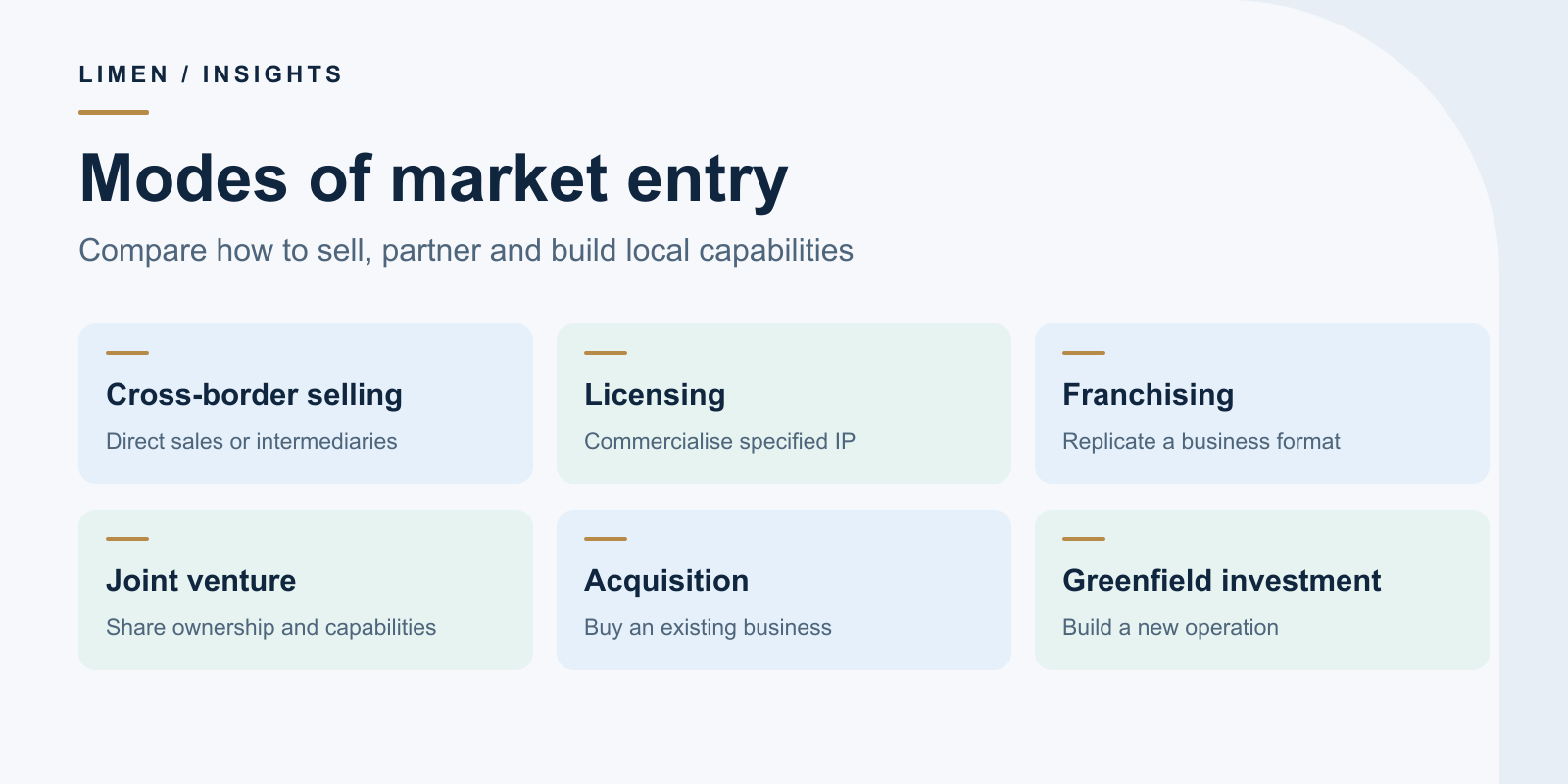
There are six main entry modes: exporting, licensing, franchising, joint ventures, acquisitions and greenfield investment. The table below summarises what each requires and the questions you need to answer before choosing it.
| Entry mode | What it involves | What you need to assess |
|---|---|---|
| Exporting / selling across borders | Supply goods or services from abroad, directly or through agents and distributors | Do you have the capabilities to acquire and serve customers from your existing operation, or are there partners who can help you overcome the local barriers? |
| Licensing | Allow another company to commercialise your technology, brand or other intellectual property | Are there interested partners with the capabilities to make the licence commercially attractive, and can you protect your IP and maintain quality? |
| Franchising | Allow local operators to run your business using its brand, format and operating system | Can another operator reproduce the business successfully, and are there suitable franchisees willing to invest and follow your standards? |
| Joint venture | Establish or own a business together with a partner | Does the partner bring capabilities you need, and can you agree on investment, responsibilities, decisions and an exit? |
| Acquisition | Buy all or part of an existing business | Does the company provide the customers and capabilities you need, and can you fund the purchase, assess its risks and integrate it? |
| Greenfield investment | Build a new local operation | Do you have the resources and management capacity to build the required team, systems, facilities and customer base? |
These approaches can be combined. You might establish a local sales team while supplying products from your home market, or build a new facility through a joint venture. Compare the actual work and investment involved: a small sales office requires different resources from a factory, even though both involve building a local operation.
What does each mode involve in practice?
Selling across borders: direct sales, agents and distributors
Selling across borders means supplying goods or services to customers in another country from your existing operation. For a manufacturer, this might involve shipping products abroad. For a software or services company, it could mean selling and delivering remotely.
If you sell directly, your team needs to generate leads, convert customers and organise delivery and support. You retain the customer relationship, but you also need the language skills, market knowledge and availability to manage it. An approach that works in your home market may need to change because customers use different channels, expect a different sales process or need more local support.
In some markets, these differences are relatively easy for your existing team to address. In others, they can become a real barrier. In China, for example, building trust through personal relationships and face-to-face meetings can be important, while language differences may require Chinese-language sales materials, training and support. Trying to sell entirely from abroad can therefore be more difficult than the product itself would suggest.
A local agent or distributor may help you overcome these barriers. An agent usually helps find and develop customers for a commission, while a distributor normally buys and resells products on its own account. Agree who contracts with customers, holds stock and handles support, how pricing and margins work, and what market information the partner will share.
The choice between direct sales and partners depends on your current capabilities and how well they fit the target market. It also depends on whether there are partners with an existing customer base, relevant expertise and a reason to prioritise your product. A distributor carrying competing products may offer access to customers but give your business little attention, so assess the commercial incentives, margins and support required on both sides.
Netflix shows how online delivery can support expansion into many markets at once. In January 2016, it made its streaming service available in more than 130 additional countries at once. Most new markets initially received a largely English-language service, with further localisation planned. This approach suited a product customers could access online, although language, content rights and local requirements still affected where and how it could be offered.
Licensing: expanding through another company's use of your IP
Licensing gives another company permission to use specified intellectual property, such as technology, a brand or a production process, in exchange for agreed payments. You retain ownership of the IP, while the licensee receives the rights defined in the agreement.
This can make sense when another company has the production capacity, distribution or local expertise to commercialise something you own. But you first need to establish whether there are suitable companies interested in doing so. Would access to your technology or brand help them build a profitable business? What would they need from you, and would the expected income justify your own support and oversight?
Disney used licensing to bring its theme-park brand to Japan. Oriental Land signed a licence agreement with Walt Disney Productions in 1979 and opened Tokyo Disneyland in 1983. The arrangement combined Disney's intellectual property with a local company responsible for developing and operating the park.
There are also risks if the partner is unreliable. It may fail to pay royalties, use the IP beyond the agreed scope, disclose confidential know-how or sell products that damage the brand. Before granting rights, assess the partner's financial position, reputation and ability to deliver, and define the territory, permitted uses, quality standards, reporting, payment and termination terms. An exclusive licence can also limit your ability to work with another partner if the first one underperforms.
The agreement needs legal review for the relevant markets, including how you could enforce your rights if something goes wrong. In this context, licensing means another business commercialising your IP; a software subscription containing a licence is not automatically this type of market entry.
Franchising: allowing local operators to run your business format
Franchising allows local operators to run a business using your brand, operating model and support in return for agreed fees. For this to work, you need a business that another operator can reproduce, with training, supplier arrangements, operating procedures and quality checks that support consistent delivery.
McDonald's uses this approach internationally through franchisees, including developmental licensees who develop and operate restaurants in particular markets. Local operators invest in the business and bring knowledge of their customers, while McDonald's provides the brand, processes and support. The operating system behind the restaurants is part of what makes the model repeatable.
You also need to establish whether suitable franchisees want to invest. They need to see a viable business after the franchise fees, local costs and investment required, while being willing and able to follow your standards. If the business still depends on the founder's personal involvement or informal ways of working, it may need further preparation before it can be franchised.
A key risk is that a franchisee's actions can affect the reputation of the whole brand. Poor service, inconsistent quality or failure to follow the operating system may damage customer trust beyond that location. There is also a risk that a franchisee leaves and tries to build a competing business using the knowledge and relationships developed during the franchise.
For that reason, assess partners carefully and plan the ongoing training, monitoring and support. The agreement should address confidentiality, brand use, breaches and what happens when the relationship ends. Restrictions on later competition need to be assessed under the relevant country's law; they are not automatically enforceable everywhere. WIPO's guide to managing IP in franchising explains these issues in more detail.
Joint ventures: sharing a business with a partner
A joint venture can involve shared ownership of a business, with each party contributing agreed resources or capabilities. Those contributions might include capital, technology, distribution, local management or access to customers.
Starbucks entered India in October 2012 through a 50/50 joint venture with Tata Global Beverages. Its first Mumbai store combined the Starbucks offer with locally sourced and roasted coffee through a separate agreement with Tata Coffee. The case shows how shared ownership can sit alongside other agreements that provide specific local capabilities.
Start by understanding what you need from a partner and what it expects from you. Local presence alone is not enough: assess the actual assets, relationships and people the partner would bring, and how these would help the company sell and operate in the market.
You also need to agree how the business will be governed. Who makes commercial decisions? Which investments require both parties to agree? What happens if one partner wants to invest more, change direction or leave? The arrangement should support the work you intend to do together, including how disagreements will be resolved.
A commercial partnership does not always require shared ownership. If the main need is distribution or implementation support, compare an ordinary partner agreement with a joint venture before deciding that a jointly owned business is necessary.
Acquisitions: buying capabilities which already exist
An acquisition can provide an existing customer base, employees, systems and local relationships. Whether you acquire all or part of the company determines the ownership and decision rights you obtain.
Walmart expanded its position in Indian e-commerce by acquiring approximately 77% of Flipkart in August 2018. Buying into an established local platform gave it an existing e-commerce business to develop, rather than requiring it to build that operation from scratch. The question for an acquirer is whether the target provides the specific capabilities its expansion needs and whether they justify the price.
Due diligence is important because the business may have problems that are not apparent from its headline results. Earnings may depend on one-off sales, a few customers or employees who intend to leave. There may also be legal liabilities, operational weaknesses or systems that require more investment than expected. Even a detailed review can miss important issues, especially if it focuses on the accounts without examining customers, people and how the company actually works.
The integration work needs equal attention. You may need to combine systems, retain key employees, clarify responsibilities and change how the businesses serve customers. Include that investment and management time alongside the purchase price, and define who will be responsible for achieving the expected results.
In PwC's 2026 M&A Integration Survey, about one third of surveyed acquirers fully achieved all their prioritised deal objectives. The survey covered executives involved in deals during the previous three years at companies with annual revenue of at least $1 billion. Meeting the goals of an acquisition therefore requires a plan for what needs to happen after the purchase, as well as a convincing reason to buy the business.
Buying a suitable operation can provide capabilities sooner than building them, but finding a target, assessing it and completing the transaction can also take time. Compare realistic alternatives for the particular market rather than treating acquisition as the fastest route in every case.
Greenfield investment: building the local operation yourself
Greenfield investment means establishing new activities rather than buying an existing business. Depending on your model, this could involve a sales team, service operation, warehouse or production facility.
Building the operation gives you the opportunity to design its systems, team and ways of working around your needs. It also means that the capabilities and customer relationships are yours to develop. Define what must be in place before you can serve customers and what can be added as demand grows.
LEGO developed its Asian manufacturing presence by building a new factory in Jiaxing, China, which officially opened in November 2016. It established its own production facility using the same global standards as its other factories. This illustrates the work behind greenfield expansion: the company creates the operation it needs, including the facilities, team and production processes.
The required commitment varies considerably. A small sales operation and a manufacturing facility have different funding, staffing and timing requirements. Greenfield also describes how the investment is established; it does not, by itself, mean that your company owns the whole business. A new operation can be built with a joint venture partner as well.
This route may be worth considering when the market is important to your plans, you need specific capabilities which are difficult to obtain elsewhere, and your team can support building them. Compare the work with what an acquisition or partner arrangement could provide before committing.
How should you choose an entry mode?
Once you understand the options, compare a small number of arrangements which could actually work for your company. What we usually recommend is to start with the customer and delivery requirements, then assess the capabilities, resources and economics behind each option. You may need an initial view during market selection if the required operation would be difficult to fund or organise, then refine the choice as you learn more about the market.
Start with what customers need from you
How do customers expect to buy, receive and use your offer? A standard product sold through established retail channels creates different requirements from a service which needs local implementation and ongoing support.
Identify which activities require your direct involvement and which could be provided by a partner. For example, a distributor might give you access to retailers, while a specialist implementation partner helps a software customer put the product into use. The arrangement should solve a specific commercial or operational need.
Compare what you have with what you need to build or obtain
Assess the people, product knowledge, language skills, systems and management capacity available for expansion. If the company cannot yet support additional customers reliably, a change of entry mode may not resolve the underlying problem. You can read more about assessing these gaps in this article on expansion readiness.
Where a capability is missing, compare the practical ways to obtain it. Hiring, finding a partner and acquiring a business can each involve substantial preparation. Assess specific candidates and costs rather than assuming that a partner will provide everything the company lacks.
Define the control and information you need
Control matters where a decision affects the value of your offer or the quality of the customer experience. Decide which responsibilities you need to retain and how you would monitor the activities handled by other organisations.
For a partner arrangement, this might include access to customer feedback, agreed service standards, reporting and a clear division of commercial responsibilities. For an owned operation, you still need management systems and people who can apply them. Ownership alone does not ensure that the team will execute effectively.
Compare the full business case
Include the resources needed before entry and while the business develops. Depending on the arrangement, this can involve product localisation, recruitment, partner support, stock, customer acquisition, acquisition integration and ongoing service.
Then assess what happens if sales take longer than expected or the local work is more demanding. A market can be strategically attractive but still require investment the company cannot sustain. It may make sense to narrow the initial scope, prepare further or choose another opportunity.
Check constraints and define a test
Product, regulatory and contractual requirements can affect which arrangements are feasible. Establish the requirements for the specific activity and country with appropriate specialist support, then include them in the comparison. Avoid assuming that every market needs the same legal structure or local partner.
Before making a larger commitment, identify which assumptions can be tested. You might assess demand through initial sales, test whether a prospective partner can generate relevant customer conversations, or establish the actual support required for a small group of customers. You can read more about organising this work in this article on market demand validation.
Apply the comparison to a specific business
Imagine a manufacturer comparing a distributor, a local sales office and the acquisition of an existing business. A distributor may already reach the relevant retailers and handle stock and deliveries, but the manufacturer needs to assess its margin and access to customer information. A sales office could give the company a closer customer relationship, while leaving it to organise stock, delivery and support separately.
An acquisition might provide several of those capabilities together, but the company would need to fund the purchase and integrate the business. Compare the arrangements against the same requirements: customer coverage, delivery, service, management capacity and expected financial results. This helps you see which work each option actually addresses and what remains for your own team to do.
Can you combine or change entry modes?
Your initial arrangement does not have to remain the same throughout the expansion. As the business develops, you may find that the local work, customer opportunity or partner requirements justify a different model. Any change needs to account for existing agreements, customer relationships and the cost of the transition.
Starbucks provides a concrete example of changing ownership and partner involvement. It bought the remaining half of its East China joint venture in December 2017. In April 2026, it completed a new China joint venture with Boyu Capital, with Boyu-managed funds holding 60% of the retail operations and Starbucks retaining 40% and its brand rights. The change shows why shared ownership should be assessed against the company's current objectives, rather than treated as a temporary step which every business eventually outgrows.
For a smaller company, the change might involve building a local team after selling from abroad, or combining its own sales activity with a specialist partner. Plan the responsibilities and transition carefully so that developing the new arrangement does not disrupt existing customers.
Develop the wider market entry strategy
Once you have selected an entry mode, you still need to define how the business will succeed in the new market. That means deciding which customers to target, what you will offer, how you will reach them, what needs to be localised, who will do the work and how the business is expected to make money.
These decisions belong together in your market entry strategy. They should lead to a practical plan with responsibilities, investment, timelines and clear criteria for deciding whether to scale, adjust the approach or stop. You can read more about developing that strategy in this article on the six-step market entry framework.
If you are comparing entry options for a new market, LIMEN can help assess the requirements, capabilities and business case behind them. Book a free 30-minute consultation to discuss your plans and the support you need.