TL;DR
- International expansion readiness shows whether your company has the goals, resources and capabilities required to enter a new market.
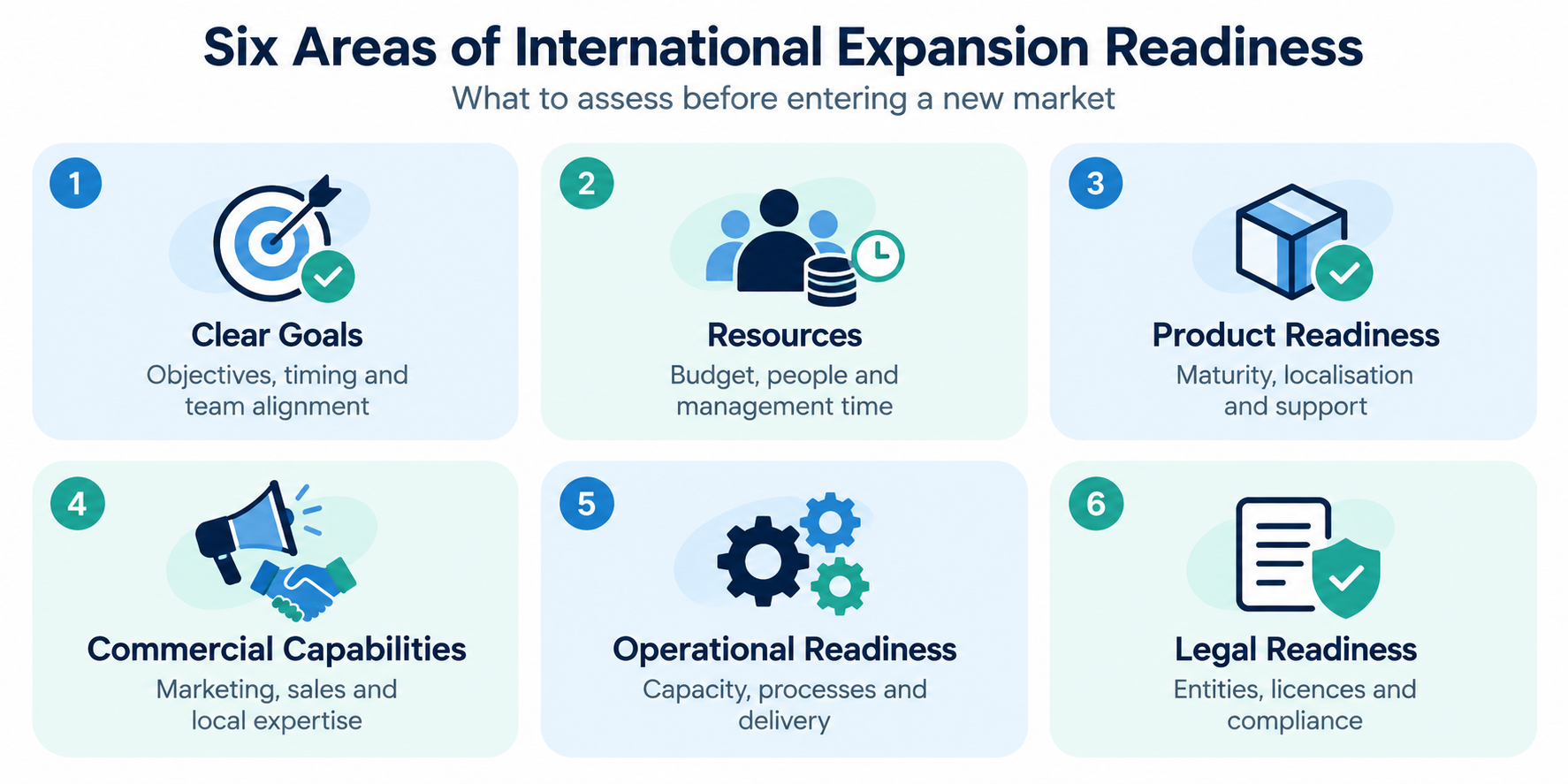
- There are six areas of readiness you should assess: goals, resources, product, commercial capabilities, operations and legal readiness.
- Compare your expansion goals with available resources: the budget, people and management time you can commit, including what you would need if sales take longer than expected.
- Once you have identified which gaps can be addressed during preparation and which could block the expansion, define the actions, owners, timing and investment needed to close them.
When companies think about international expansion, the first question is often where they should expand. But there is another question that should come first: is the company actually ready for the expansion?
There are some basics that should be in place to give the expansion a reasonable chance of success. If they are not in place, there is usually little sense in moving forward before addressing them.
A promising market will not compensate for unclear goals, insufficient resources, a product that is not ready, weak commercial capabilities, operational limitations, or legal barriers. These problems usually increase the time and money required for the expansion. In some cases, they can make it unfeasible.
That is why assessing readiness is the first stage in our six-step framework for entering foreign markets.
An international expansion readiness assessment should cover six areas:
- Goals: Are the goals of the expansion clear and aligned across the team?
- Resources: Does the company have the money, people and management time required?
- Product: Is the product ready to scale and meet local requirements?
- Commercial capabilities: Can the company reach and convert customers in the new market?
- Operations: Can the company support the additional work and demand?
- Legal: Can the company operate in the market and comply with the local requirements?
The goal is not to prove that everything is perfect. It is to identify the gaps before you start investing heavily and decide what needs to be fixed before or during the expansion.
1. Goals of the expansion
It all starts with having a clear understanding of why you are expanding.
A company might want to generate additional revenue, increase profitability, diversify the political or economic risks of operating in its existing markets, or build a truly global business. All of these goals can make sense. But they can lead to very different decisions about markets, investments and timing.
For example, a company looking for revenue in the next twelve months may prioritise an accessible market where it can start selling quickly. A company trying to build a global position may be prepared to invest for much longer before seeing significant returns.
It is equally important to make sure that the management team shares the same understanding of the goals. We have seen companies struggle because different people had different expectations. One person expected quick revenue, another saw the expansion as a long-term investment, and the team responsible for execution did not understand how much work would be required.
Before moving forward, answer these questions:
- Why do we want to expand into new markets?
- What results do we want to achieve?
- How important are revenue, profitability, risk diversification and long-term growth?
- Within what timeframe do we expect to achieve those results?
- Does the management team agree on these goals and expectations?
If different members of the team give very different answers, the company is not yet aligned on the expansion.
2. Resources
The next question is whether the company has the resources required to achieve its goals.
Money is the most obvious resource. International expansion usually requires investment before it generates meaningful returns. Depending on the business, this could include research, product adaptation, legal setup, recruitment, travel, marketing, sales and local operations.
People and management time are equally important. Someone needs to own the expansion, make decisions and coordinate the work across different functions. Founders and senior managers often underestimate how much of their own time this will require. If the existing team cannot take responsibility for the new market, the company may need to hire a local manager or build a separate expansion team.
A common problem is that the company has unrealistic expectations about how quickly it will earn money or how little management time the expansion will require. When the results take longer than expected, the company stops because it does not have enough resources to continue. In other cases, it continues but does not invest enough to give the expansion a reasonable chance of success.
Ask yourself:
- How much are we prepared to invest before the expansion starts generating returns?
- For how long can we support the expansion if the initial results are slower than expected?
- Who will own the expansion?
- How much time can the management team dedicate to it?
- Do we have all the people required to work on the expansion, or who do we need to hire to close the gaps?
The key is to compare the goals with the resources you are actually prepared to commit.
3. Product readiness
Another important area is the maturity of the product and everything around it.
First, is the product itself ready to scale? Companies that have not yet achieved product-market fit in their existing market sometimes see international expansion as a way to solve their growth problems. But expansion rarely fixes the underlying product issues. It usually makes them more expensive.
Second, the product may also need to be localised. This can include the language, technical specifications, product features, packaging, payment methods, onboarding, documentation and customer support. In some cases, it should also be adapted to local cultural expectations.
For example, we worked with a company producing children’s furniture. In its initial market, the company sold a chair on its own. In the US, it was common for the chair to include a small attached table because children often did not sit directly at the dining table. The company therefore had to adjust the product and its production process for that market.
Review the following questions:
- Is the product mature and ready to support more customers?
- Can it meet the technical and quality requirements of the new market?
- Does it need to be translated or adapted to the local language?
- Are the website, commercial materials, onboarding and documentation ready?
- Can you provide customer support in the required language and time zone?
- Does the product need to be adjusted for local habits or cultural expectations?
The important point is to assess the entire customer experience, not only the core product.
4. Commercial capabilities
Next, the company needs the marketing and sales capabilities required in the new market.
A commercial approach that works in one country may not work in another. Customers may use different channels, expect communication in the local language, follow a different sales process, or respond to different advertising messages. Even when the product and target customer appear similar, the way you reach and convert them can differ significantly.
It is useful to understand in advance which marketing and sales channels are used in the new market. You can then assess whether the existing team can cover them or whether you need additional people, partners or local specialists.
For example, for many B2B sectors in China, sales depend heavily on relationship-building. Trying to manage the entire sales process remotely and in English can make it very difficult to close deals. A local sales representative with the right language skills and market understanding may be essential.
Ask yourself:
- Do we understand how customers in the new market discover and evaluate products?
- Which marketing and sales channels are most important?
- Can our existing team operate those channels effectively?
- Is the local language required for marketing, sales or customer relationships?
- How does the local sales process differ from the one in our existing market?
- Do we need local salespeople, marketing specialists, distributors or other partners?
Otherwise, you risk entering a new market with a leaking bucket: you invest in acquiring potential customers, but your commercial process is not capable of converting them.
5. Operational readiness
Expansion can essentially create a new full-scale business in parallel to your existing business. This can use a significant part of your existing capacity and put more strain on your processes. The company therefore needs enough capacity and scalable processes to support it.
This can affect customer support, procurement, production, logistics, finance, legal work, marketing and sales. Processes that work well for one country may become much more complicated when the company needs to support different languages, currencies, time zones, suppliers, regulations and customer expectations.
The question is not only whether the company can start selling in the new market. It also needs to be able to deliver the product, support the customers and manage the additional work after those sales begin.
Review these areas:
- Can production or service delivery support the additional demand?
- Can procurement and logistics cover the new market?
- Can customer support operate in the required language and time zone?
- Are the finance, reporting and payment processes ready?
- Can the marketing and sales teams manage another market?
- Which processes need to be adapted or built from scratch?
- Who will coordinate work across the different functions?
If the current operations are already under pressure, expansion may create additional problems in both the new and existing markets.
6. Legal readiness
Finally, the company needs to understand whether it can legally operate in the target market.
Depending on the country and industry, you might need to establish a specific type of legal entity, obtain licences, secure product certifications, register intellectual property, prepare local contracts, meet employment requirements, or comply with restrictions on payments and the movement of capital.
For example, data privacy can become a major issue. The EU’s General Data Protection Regulation applies to many companies outside the EU when they offer goods or services to people in the EU or monitor their behaviour. For some data-driven companies, the changes required to comply with local privacy rules can make the existing business model unviable unless it is adapted.
Before expanding, answer these questions:
- Is the company legally permitted and ready to sell its product or service in the market?
- If a local legal entity is required, are we ready to establish and operate it?
- Have we identified the required licences, permits and product certificates, and can we obtain them?
- Do we understand and can we comply with any restrictions on ownership, intellectual property or capital movements?
- Are the contracts and legal documents adapted to the local requirements?
- Are we compliant, or do we have a clear plan to become compliant, with the relevant tax, employment, consumer protection and data privacy requirements?
- How long will the legal setup take, and how much will it cost?
This does not mean that every legal requirement must already be completed before the expansion starts. But you should understand the requirements and make sure there are no barriers that make the expansion unrealistic.
How to assess your international expansion readiness
The assessment itself can be relatively straightforward.
For each of the six areas, collect the available evidence and classify the company as:
- Ready: The required capabilities are already in place.
- Needs work: There are gaps, but they can be addressed during the preparation or early stages of the expansion.
- Blocker: The gap could prevent the expansion from succeeding and needs to be resolved before substantial investment.
Do not base the assessment only on the opinion of one founder or manager. Involve the people responsible for product, commercial activities, operations, finance and legal work. Differences between their answers can reveal gaps that are otherwise easy to miss.
The final output should be a clear list of gaps, the actions required to close them, the people responsible, and the expected timing and investment.
For one wood-processing company, we conducted a detailed assessment before the company committed significant resources to international expansion. This helped us define the commercial, operational and legal requirements for each market and build a clear plan for the expansion. The company then signed its first international contracts worth several million euros.
Identify the gaps before you expand
An international expansion readiness assessment does not decide whether a market is attractive. That comes next, during market research and prioritisation. It shows whether your company is in a position to pursue the opportunity and what needs to change before you invest heavily.
If you are planning an international expansion, LIMEN can assess your goals, resources, product, commercial capabilities, operations and legal readiness. The result is a clear view of the main gaps and the actions required before you move forward.
Book a free 30-minute consultation to discuss your expansion and readiness assessment.