Developing a market-entry strategy is only part of the work. The company then needs to turn it into measurable outcomes, actions, clear ownership and a regular management process.
This is where many market-entry strategies fail. The company might have a good plan, but the strategic priorities are not translated into measurable outcomes and concrete actions. Ownership is unclear, progress is reviewed too late, or the company continues executing the original plan even when the evidence shows that something needs to change.
Market entry execution therefore includes more than completing a list of launch activities. It requires a management system that connects the strategy, execution plan, accountability, performance tracking, problem-solving and strategic adaptation.
The process below is comprehensive. A smaller company entering a relatively simple market might decide to simplify it. However, we generally recommend covering all eight areas and adjusting the level of detail to the scale and complexity of the expansion.
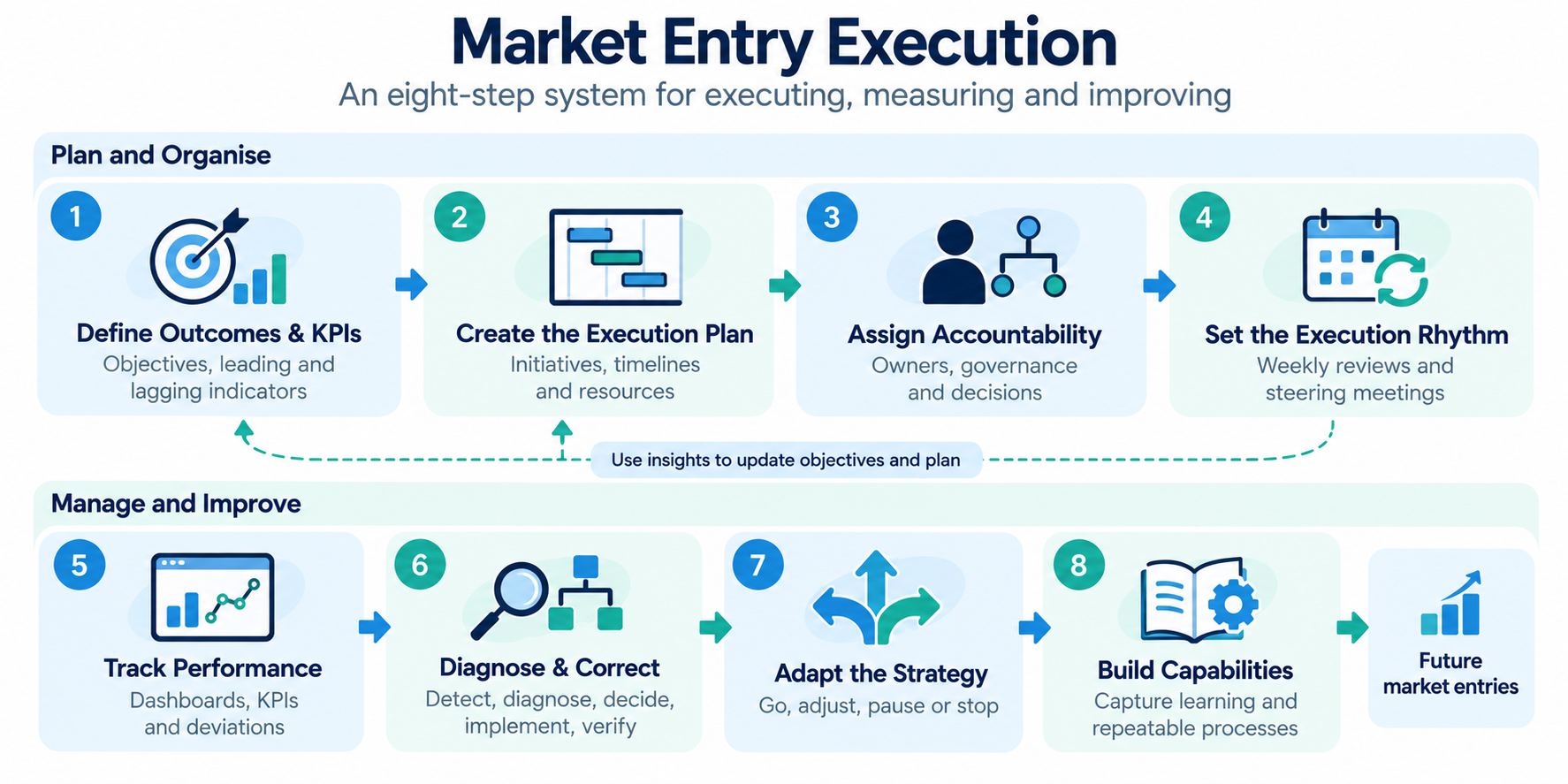
An eight-step system for executing, measuring and improving a market-entry strategy.
1. Translate the strategy into measurable outcomes
A strategy usually defines where and how the company wants to compete. Execution management requires turning those strategic choices into measurable commitments.
A market-entry strategy might say: “Enter Germany through direct sales and local partnerships, targeting mid-market B2B clients.”
This direction is useful, but the team still needs to define what should be achieved, by when, and how progress will be measured.
Start with the commercial targets and important milestones. Then select a limited number of KPIs across three categories:
-
Execution KPIs. These measure whether the planned work is happening. Examples include legal setup completed, local sales materials prepared, partners onboarded or outbound campaigns launched.
-
Leading KPIs. These show whether the activities are starting to generate commercial momentum. Examples include meetings booked, qualified opportunities, proposals sent, pipeline value and trial conversions.
-
Lagging KPIs. These measure the final business results. Examples include signed customers, revenue, gross margin, retention and return on investment.
It is important to track both inputs and outcomes. Amazon has described its focus on the controllable inputs that teams can influence, alongside financial outputs such as revenue and profit. This makes it easier to distinguish a problem with execution from a problem with the original strategy or business case.
The output of this stage should be a clear set of market-entry objectives and a KPI scorecard.
2. Create an actionable execution plan
Once the outcomes are clear, break the strategic priorities down into initiatives and actions.
Each initiative should include:
- the expected outcome and related KPI;
- the specific actions required;
- one accountable owner;
- deadlines and milestones;
- dependencies on other activities;
- the people, budget and other resources required.
The individual workstreams should then be combined into one integrated plan. Depending on the market entry, these could include product localisation, legal setup, recruitment, partnerships, marketing, sales, operations, customer support and finance.
Pay particular attention to the dependencies and potential bottlenecks. The critical-path method can help identify which delays would affect the entire launch. A Gantt chart can then show how the workstreams and milestones connect over time.
It is also useful to define clear stage gates, for example every 90 days. At each gate, the team reviews the progress and decides whether the next level of investment should be approved.
For example, when we were supporting a wood-processing company in scaling its international sales, we defined the exact channels, actions, timelines and expected results for each market. The plan was used to track progress and identify where the company was performing better or worse than expected. It also made it much easier for the sales team to execute.
3. Establish clear accountability
Every initiative needs one accountable owner. When responsibility is shared between several people without one clear owner, decisions are delayed and problems can remain unresolved for too long.
The owner should understand the expected result, have access to the required resources and know which decisions can be made independently. The team should also know which decisions need to be escalated.
For a larger market entry, establish a clear governance structure. This could include:
- an executive sponsor responsible for the overall success of the expansion;
- a steering committee that reviews the major decisions and resource requirements;
- initiative owners responsible for individual workstreams;
- a programme or project manager coordinating the integrated plan.
A RACI matrix can clarify who is Responsible, Accountable, Consulted and Informed for the most important activities and decisions. The purpose is not to create additional bureaucracy. It is to make ownership and decision-making clear before problems appear.
4. Introduce a structured execution rhythm and execute
The plan now needs to become part of the company’s regular management rhythm. Teams should implement the planned actions and review progress often enough to identify problems while there is still time to address them.
A practical rhythm could include:
- weekly operational reviews for initiative owners;
- monthly management or steering-committee reviews;
- additional reviews when an important milestone or stage gate is reached.
The weekly review should focus on what was completed, what needs to happen next, where the team is falling behind and which decisions or support are required. The steering committee should focus on the larger issues, including resources, dependencies, risks and changes to the plan.
Project-management tools such as Asana or Jira can help track actions, owners, deadlines and dependencies. The tool is less important than having one shared source of information that the team actually uses.
In its own transformation work, McKinsey uses a disciplined management approach with initiative owners, structured stage gates, weekly reviews and executive intervention when initiatives run into problems. It also uses one source of truth for progress and value tracking.
5. Track performance against the plan
Execution should be tracked from several perspectives. Monitor whether the planned activities are happening, whether they are producing commercial results, how many resources are being used and where actual performance differs from the plan.
Google uses the OKR framework to connect its main objectives with a limited number of measurable key results. This helps teams focus on the main priorities, align their efforts and track whether the objectives are being achieved.
A KPI dashboard should combine the most important indicators without becoming too complicated. It might include:
- completion of activities and milestones;
- marketing and sales activity;
- qualified pipeline and conversion rates;
- customers, revenue and margin;
- customer acquisition cost and retention;
- budget, team capacity and total investment;
- timing against the original plan.
The review frequency should depend on the type of metric:
- Weekly: execution activities, immediate bottlenecks and leading indicators.
- Monthly: pipeline, conversions, budgets and initiative performance.
- Quarterly: progress against the business case, strategic assumptions and resource allocation.
- Annually: the overall market portfolio, long-term returns and capabilities required for the next stage of growth.
The exact metrics will depend on the business, but they should connect directly to the goals and business case defined at the beginning. A market can generate sales and still be unattractive if it takes much longer or costs much more than expected.
6. Diagnose deviations and implement corrective interventions
When performance differs from the plan, the first response should not automatically be to increase the activity. You need to understand why the deviation occurred.
A useful five-step loop is:
- Detect. Identify the deviation from the target or plan.
- Diagnose. Determine the most likely root cause.
- Decide. Select the corrective action and define the expected impact.
- Implement. Put the intervention into practice with a clear owner and timeline.
- Verify. Check whether the intervention improved the result.
Root-cause analysis, funnel analysis and the 5 Whys can help structure this process.
For example, you might enter a market expecting direct sales to perform as they do at home. After a few months, the number of leads may be sufficient, but the conversion rate much lower. Customer conversations may show that buyers expect a local reference or partner.
Simply increasing the number of leads would not solve this problem. A better intervention might be to test a local representative, develop a partnership or secure the first reference customer and then measure whether conversion improves.
This is also where experienced external support can add substantial value. The job is not only to identify that performance is below the target. It is to conduct the problem-solving, design a focused intervention and help the team verify whether it worked. Previous experience can help identify likely causes and possible solutions faster.
7. Adapt the strategy based on evidence
Some deviations can be corrected through better execution. Others indicate that one of the original strategic assumptions was incomplete or wrong.
For example, the company may discover that the selected segment has less demand than expected, the price is too high, the preferred channel does not provide enough access to customers, or the local operating model costs much more than planned.
In this case, the company needs to review the strategy rather than continue pushing the same execution plan. The product, target segment, pricing, positioning, channels, entry mode or business case may need to change.
At each major stage gate, make one of four decisions:
- Go. Continue with the strategy and approve the next investment.
- Adjust. Change part of the strategy or execution plan and continue testing.
- Pause. Stop additional investment until a specific condition is resolved.
- Stop. Exit the market or redirect the resources to another opportunity.
If the market is responding well, you can scale faster. If the results are mixed, adjust the approach and test the changes. If the gap between expectations and reality remains too large despite several iterations, stopping can be the right decision.
8. Institutionalise learning and capabilities
The final step is to capture what the company has learned and turn it into repeatable processes for the future.
Document which market assumptions were correct, which entry approaches worked, where the company faced delays, which capabilities were missing and what should be done differently next time.
The outputs could include:
- a reusable market-entry playbook;
- templates for prioritisation, planning and performance tracking;
- a database of partners, suppliers and other market contacts;
- standard governance and review processes;
- training and capability transfer to the internal team.
The goal is to make each future market entry more efficient. The company should not need to recreate the entire process from the beginning every time it expands.
Put the framework into practice
Market entry execution is a continuous cycle. You translate the strategy into measurable outcomes, create the plan, assign ownership, execute, track the results, diagnose the gaps and adapt the strategy. Then you capture what worked and use it in the next market.
The framework can be simplified for smaller expansions, but the main questions still need to be answered. What are we trying to achieve? Who owns the work? How will we know whether it is working? What will we change if the results are different from the plan?
At LIMEN, we help companies turn international expansion strategies into execution plans, establish the management rhythm, solve implementation problems and build the capabilities required to scale.
If you are preparing to execute a market-entry strategy, book a free 30-minute consultation.