TL;DR
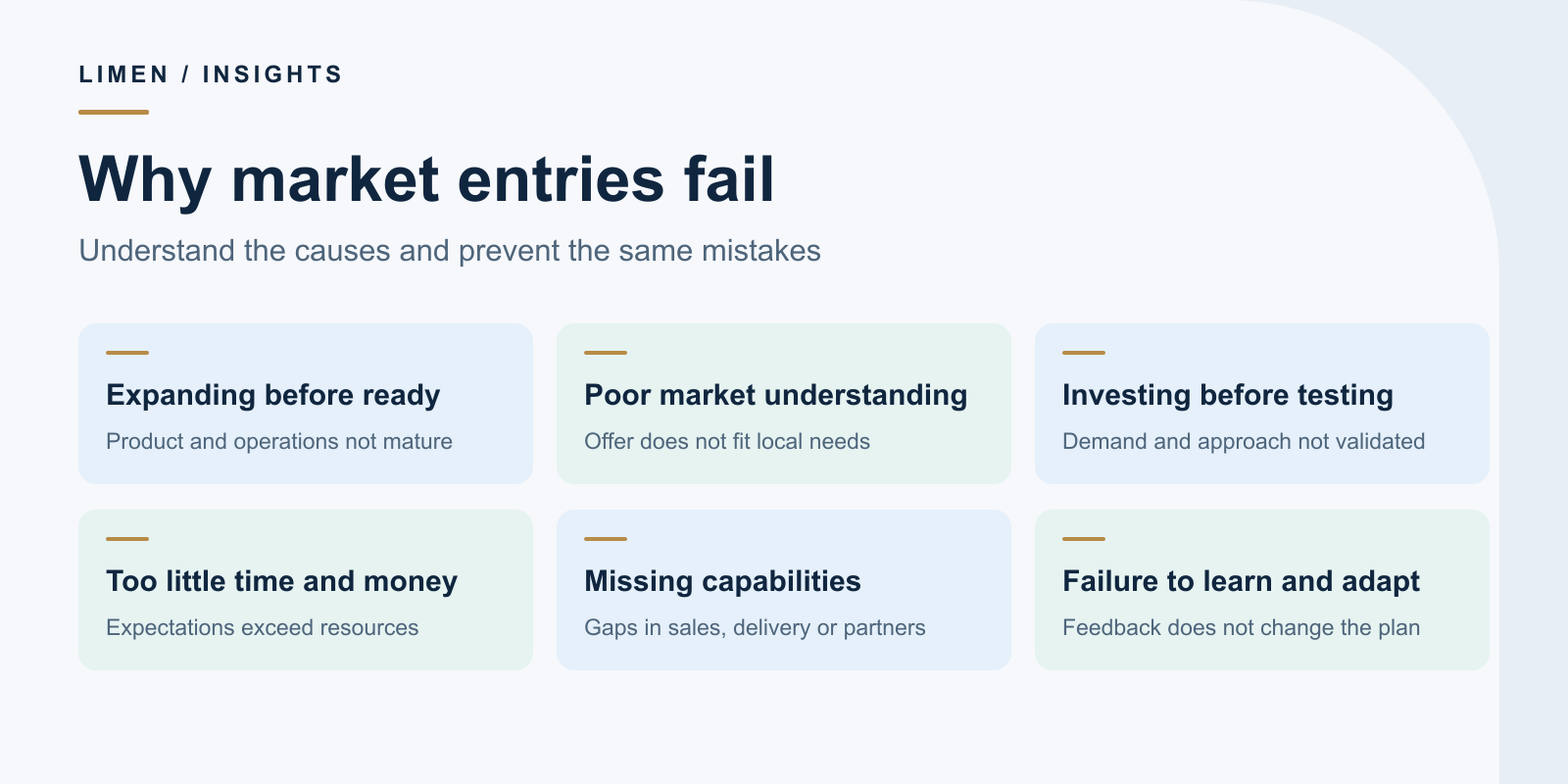
- We see six main reasons market entries fail: expanding before the company is ready, misunderstanding the market, investing before testing demand, underestimating resources, missing capabilities and failing to adapt.
- Before expanding, assess product-market fit and the maturity of your existing operations. Your strategy should then reflect the new market's customers, competition, channels and decision-making culture.
- Validate demand and the proposed approach before committing to full-scale expansion. Plan the money, management time and commercial and operational capabilities needed while sales develop.
- During execution, use customer feedback and commercial results to adjust the offer, channels and operating model. If the problems cannot be resolved within your resources, reconsider the investment or withdraw.
In a 2006 publication, Bain & Company reported that more than 60% of geographic expansion moves failed entirely. Even companies with successful products, established brands and substantial resources can struggle to build a viable business in a new market.
A market entry fails when it does not achieve the goals that would justify the investment. The company may win some customers but be unable to generate the revenue, profitability or growth it expected. If it cannot find an approach that works within the resources it can commit, it may eventually leave the market.
In our experience, there are six main reasons market entries fail:
1. Expanding before the business is ready
Some companies start looking for growth abroad while they are still struggling to establish the business in their existing markets. They may not yet have found product-market fit, developed a repeatable sales approach or built operations that can reliably support their customers. Entering another market adds more work before those issues have been resolved.
For example, if you still do not understand why customers buy your product or why others stop using it, it will be difficult to know which parts of the offer to take into a new market. And if delivery depends on the founder personally solving every problem, adding customers abroad can put both the new and existing business under pressure.
Readiness also matters for companies whose home business is already successful. Target opened its first Canadian stores in March 2013 and launched 124 stores within nine months. Many Canadians knew the brand from shopping in the US, but the new operation struggled with inventory and pricing, and the customer experience did not meet expectations. In January 2015, Target announced its withdrawal after concluding that it could not identify a realistic route to profitability before at least 2021.
In its explanation of the exit, Target acknowledged that it had taken on too much too quickly. The company had a successful business in the US, but the Canadian operation still needed to be capable of delivering what customers expected.
Before expanding, assess whether your product is valued by customers, whether you can acquire and serve them consistently, and whether the organisation can support the additional work. Some gaps can be addressed during preparation, while others need to be resolved before you increase the investment. You can read more about this in the article on international expansion readiness.
2. Not understanding the new market well enough
Another common mistake is to assume that the new market will work much like the existing one. The company takes its current product, sales approach and pricing abroad without making enough effort to understand what needs to change.
But each market can differ in customer needs, competition, marketing and sales channels, local buying processes and business culture. Buyers may use different systems, expect a local service, involve more people in procurement or require a relationship before they are willing to discuss a deal. The alternatives they already have may also make your offer less attractive than it is at home.
Sendcloud initially approached Germany with its Dutch solution and insufficient local market knowledge. The entry ran into difficulties, and the company subsequently changed how it prepared for new markets. It researched which webshop systems, carriers and delivery expectations mattered locally. For a shipping platform, these requirements affect whether customers can use the product in their own operations.
Before defining your entry strategy, speak with potential customers, partners and people who understand the industry locally. Find out how buyers choose suppliers, which alternatives they use, what they expect from the product and how they want to be approached. Use those findings to decide which customers to target, what to offer and how to sell and deliver it. Market size alone will not answer those questions.
3. Committing to full-scale expansion before testing demand
Research helps you develop a strategy, but you still need to see how the market responds to your actual offer. If you commit to a full launch before testing it, you may discover important problems only after hiring people, adapting the product or establishing operations.
During a market test, customers can reveal requirements you did not foresee. They may want an integration before they will buy, take longer to decide than expected or respond through a different channel. You may also find that the price is unattractive or that serving the customer requires more work than the business case allows.
This is why we recommend testing the main assumptions before increasing the investment. Select a customer segment, prepare a specific offer and use a limited sales campaign, paid pilot, pre-sale or partner test to check the response. The approach should reflect your business model and the investment required to put the offer in front of customers.
A fashion brand supported by our partners tested the market through a B2B marketplace and a B2C distributor before investing in its own direct-to-consumer operation. The work began with conversations with brands that had already entered the market to understand the challenges they had faced. This allowed initial demand to be checked through existing channels before building a more extensive operation.
The purpose of the test is to find out what is realistic and what needs to change. Positive feedback can justify another step, but it does not necessarily justify a full local team or a large marketing budget. Define the results you need before starting, then use what you learn to proceed, adjust or stop. You can read more about the approaches and the fashion-brand example in this article on market-demand validation.
4. Underestimating the time and money required
Founders can have unrealistic expectations about how quickly a new market will generate revenue and how little they will need to invest. The plan may assume that a salesperson will bring customers soon after joining, or that early sales will finance the work needed to establish the business.
In practice, the company needs to fund preparation and continue supporting the market while those sales develop. This can include product localisation, marketing, recruitment, partner development, delivery and customer support. Founders and managers also need to spend time making decisions, supporting the team and resolving problems.
The sales cycle matters as well. If customers need several rounds of discussion, a pilot, procurement approval or product changes before they can buy, revenue will take time to develop even when there is genuine interest. The company needs to be prepared to commit both money and management attention for that period.
Mollie's early European expansion illustrates the work that needs to be funded. In 2017, it provided French- and German-speaking support from Amsterdam while employing partner managers locally to build relationships. The company was financing its growth from its own resources during this period. Its expansion therefore involved maintaining support and local commercial capacity alongside the existing business, rather than only paying for a launch campaign.
For your own company, define how much you are prepared to invest and how long you can support the market before it needs to contribute the expected returns. Build the plan around the actual work and customer decision process, and consider what happens if sales develop more slowly. Include the effect on the existing business if it is providing the people, budget or management attention.
Agree what results would justify continued investment, when you will review them and how much additional time and money you are prepared to commit before that review. If progress is slower than planned, assess whether opportunities are genuinely moving towards purchase or whether the offer, channel or cost of serving customers needs to change. This gives you a basis for funding the next step, changing the approach or stopping.
5. Lacking the capabilities to sell and operate in the market
A strategy can look convincing while relying on capabilities the company does not actually have. The team may assume that it can sell remotely, that its existing sales process will work or that a local partner will bring customers. During execution, it discovers that it cannot generate enough relevant conversations, convert them into sales or support the customers it wins.
The gap can be inside your own company, within the local team or with a partner. Your salespeople may have little experience outside the home market, lack the required language skills or be unfamiliar with how local buyers make decisions. A distributor may not have the customer access you expected, or may give the product too little attention. Before appointing one, review sales of comparable products, speak with references where possible and agree what commercial work and reporting it will provide. And even a capable commercial team will struggle if the rest of the company cannot provide the demonstrations, product changes or delivery support needed to close and fulfil the sale.
Sendcloud's German experience also shows how local employees can struggle without sufficient support from the company. It closed its Berlin office and rebuilt the German team in Eindhoven, where employees could learn the product, target customers and sales approach. It later established an office in Munich. Hiring country managers had not resolved the underlying problem: the team needed the knowledge and practical support required to do the work.
For your expansion, assess the capabilities against the actual customer journey. Who will find prospects, establish trust, demonstrate the product, negotiate, onboard and support customers? Do those people have relevant experience, and what do they need from the rest of the organisation?
Where there are gaps, decide whether to train the existing team, hire, involve specialists or work with a different partner. Set clear responsibilities and check whether people can carry out the work in practice. Make sure new hires and partners understand the product, have the materials and training they need, and can get decisions and support from your team.
6. Failing to learn and adapt during execution
Entering a new market will give you information that was not available during preparation. Customers raise different objections, some channels work better than others, and delivery can take more effort than planned. The company needs to use that experience to improve its approach.
The problem comes when the team keeps following the original plan even though the results show that something needs to change. It may respond to weak sales by increasing outreach or spending more on the same channel, without understanding whether the issue is the target segment, offer, buying process or the team's capabilities.
Best Buy provides an example of changing the operating model rather than treating one unsuccessful approach as a verdict on the entire market. In 2011, it announced that it would close its own branded stores in China while continuing to invest in Five Star, the Chinese retailer it had acquired. Its restructuring announcement described Five Star as profitable at that time, distinguishing its results from those of the Best Buy-branded format.
To adapt effectively, you need a regular review of commercial results and customer feedback with the people responsible for sales, product and operations. If conversations do not lead to purchases, examine the objections and decision process. If customers buy but are difficult to serve profitably, review the offer and operating model. Agree which changes to test, who will make them and what results would justify continuing.
Adaptation also needs to happen while the company still has resources to act. If the market opportunity remains attractive and the problem can be resolved, adjust the approach and test it again. If the required changes are beyond your capabilities or the commercial case no longer works, consider pausing the expansion or leaving the market.
Prepare, test and adapt your market entry
The examples show different outcomes. Target withdrew from Canada, Sendcloud rebuilt its German approach, and companies such as Mollie committed people and resources to developing their foreign business. For your company, the useful lesson is to understand what the expansion requires before investing heavily, then keep improving the approach as you gain experience.
What we usually recommend is to assess readiness, research the markets, develop the strategy and test demand before moving into broader execution. Once you start, track the results and adapt the plan. You can read more about the full process in this six-step market entry framework.
At LIMEN, our partners work directly with founders on these decisions, from assessing readiness and researching markets to testing demand and supporting implementation. If your market entry is not progressing as expected, we can help you examine customer feedback, the sales approach and the capabilities behind it, then decide what to change before committing more resources. If you would like to discuss your situation, book a free 30-minute consultation.