TL;DR
- International expansion needs market research, a tested commercial approach and the ability to sell and deliver. Decide which activities your team has the skills and time to handle before buying outside support.
- You can strengthen your team through internal hires or work with market entry advisers, agents, distributors, outsourced sales teams, public networks and setup specialists, depending on the support required.
- Choose support for a specific gap, and compare relevant cases, results, references and the actual delivery team. Agree milestones and check the cost of continuing or changing the arrangement.
- Keep an internal owner responsible for the expansion, and agree what your team must provide, what the external provider will deliver and who will handle each stage of the customer relationship.
When you decide to expand internationally, one of the first questions is who will do the work. Can your existing team manage the expansion, should you hire additional people, or would it be better to involve specialists and local partners?
Your team already knows the company, the product and the customers you serve. If it also has the local knowledge, capabilities and time required, it can lead the work internally. Where those are missing, compare what market entry services, new hires or local partners would add before deciding how to organise the expansion.
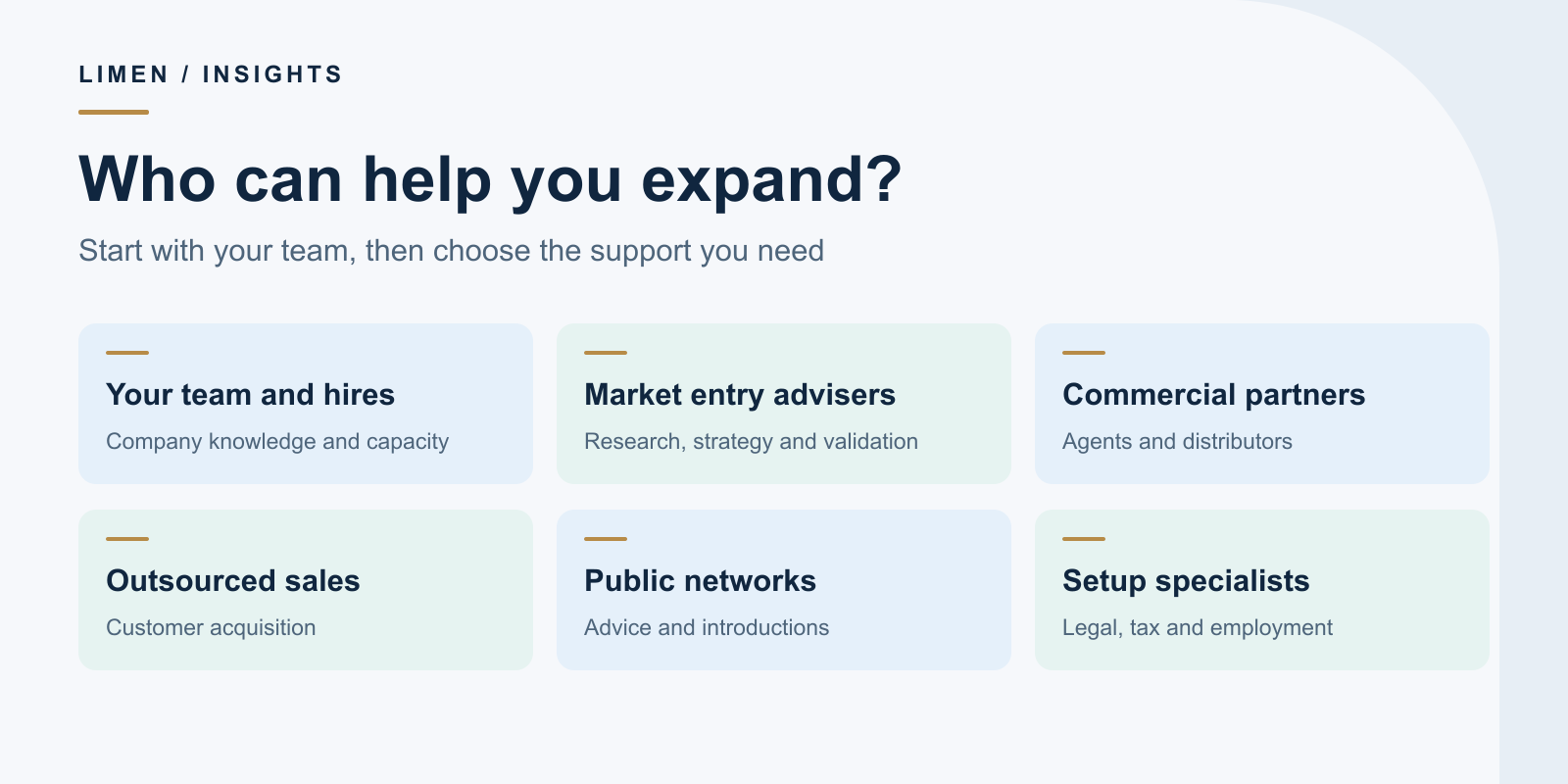
What can your company do itself?
You can prepare and manage the expansion with your own team if it can cover the main activities involved:
- Assess readiness. Agree the expansion goals and identify gaps in the company's resources, product, commercial capabilities and operations.
- Research and select markets. Understand potential customers, competition, buying behaviour, local requirements and the routes available to reach buyers.
- Develop the entry strategy. Define the target segment, offer, positioning, pricing, channels and operating model, together with the investment required.
- Validate demand. Test the offer with potential customers and assess willingness to pay, conversion and acquisition costs before scaling.
- Develop sales and partnerships. Find customers and partners, manage conversations, prepare proposals, negotiate and follow through on opportunities.
- Deliver and support the offer. Organise product localisation, onboarding, fulfilment, customer support and the processes needed to serve the new market.
- Address setup requirements. Check which tax registrations, contracts, hiring arrangements or local entity requirements apply to the way you intend to sell and operate. Obtain qualified local advice before making commitments you do not understand.
Your people understand how the product works, why existing customers buy it and what the company can realistically deliver. They may be the best people to explain the offer, speak with prospective customers and decide which changes are feasible. Keeping that work close to the business also helps the team build its own understanding of the new market.
Doing everything yourself can take longer when the team needs to learn the market, develop new skills and fit the expansion around its existing responsibilities. Knowing your product well does not automatically mean knowing where to find reliable local information, how customers choose suppliers or which partners are worth approaching.
What we usually recommend is to assess each activity objectively. Who has the relevant experience? How much time can they commit? What would they need to learn, and how would that affect the expansion timeline and the existing business? This will help you distinguish the work your team is best placed to do from the work where a specialist could add value.
If you need a continuing capability and can fund and support the role, consider hiring. For a particular decision, a limited test or a temporary capacity gap, compare a scoped external assignment with doing the work internally. You can combine these approaches as the market develops.
You can read more about the work involved in this article on developing a market entry strategy.
Which support options should you consider?
Market entry services provide outside expertise or capacity for the work your team cannot yet cover. They include research, validation, partner search, sales support and help establishing operations. The assignment should state which of these you are buying.
Compare those services with what you can do through your existing team or additional hires. The table below shows where each option can be useful and what you need to assess.
| Option | When it fits | Cost and time commitment to compare | Main risk to check |
|---|---|---|---|
| Your existing team | You have relevant skills and capacity, at any stage of the expansion. | Management time and work taken away from the existing business; learning time where skills are new. | Responsibility is assigned, but nobody has time to do the work. |
| Internal hires or a dedicated team | You need a continuing capability and can define and support the role. | Recruitment, onboarding and ongoing employment costs. | A role is built around an untested plan or lacks support from headquarters. |
| Advisers and research firms | You need to choose a market, challenge a strategy or design and assess a test. | Quoted project or ongoing fees, your team's input and any follow-on execution work. | The evidence and delivery team do not match what your decision requires. |
| Commercial partners | A relevant agent, distributor, reseller or service partner can help you reach and serve customers. | Commission or resale margin where applicable, training, support and any exclusivity commitment. | Your offer receives little attention, or the partner does not reach the buyers you need. |
| Outsourced sales teams | You have a defined offer to test or a commercial approach to execute. | Fees, any performance element, your team's sales support and time to the first meaningful test. | Meeting targets are met without qualified opportunities progressing. |
| Public agencies and networks | You need orientation, introductions or partner-search support. | Eligibility, possible charges and the commercial follow-up your team must provide. | An introduction is treated as an active opportunity without further work. |
| Setup specialists | You need to resolve requirements affecting the proposed sales, hiring or operating arrangement. | Advice and setup costs, required inputs and the time needed before relevant commitments. | The arrangement is chosen before its requirements and ongoing costs are understood. |
When comparing costs, separate what you must pay regardless of sales from amounts linked to activity or revenue. Include your own team's time, product work and ongoing support. Ask when meaningful customer conversations or other decision-making evidence will be available, and what needs to be ready first. A quoted start date is not a promise of sales.
Internal hires and a dedicated expansion team
Hiring can make sense when you expect a continuing need for a capability and want to build it inside the company. Depending on the work required, this could be a market development manager, a salesperson, a channel manager or someone responsible for local operations.
The hire does not necessarily need to be based abroad. Your existing office may be a suitable base for someone with the required language skills and market experience. A local presence becomes more relevant when customer relationships, demonstrations, delivery or ongoing service require it.
The value is that the employee can develop a deep understanding of your product and customers while building knowledge and relationships for the company over time. But recruitment and onboarding also take time, and a new hire needs access to decision-makers, product experts and delivery resources. Define a realistic role and the support it will receive rather than expecting one person to research the market, adapt the product, generate sales and establish all the operations alone.
Market entry advisers and research firms
These specialists help you assess readiness, research potential markets, develop the entry strategy and validate the commercial opportunity. A research firm with repeated experience in your sector or target market already knows which sources, customer groups and market participants to investigate. This can help it reach a useful answer faster than a team learning both the market and the research process for the first time.
If a wrong market choice would tie up a large share of your budget or distract the team from its existing business, ask an independent adviser to review the assumptions before committing. This is relevant to a local hire or a distributor agreement as well as a larger rollout. Ask the adviser to test the reasoning behind demand, pricing, channels and the financial plan, rather than simply confirm the conclusion your team has reached.
If you also need implementation support, include the activities and responsibilities in the scope. Agree who will turn the findings into the entry plan and who will carry it out.
Commercial partners: agents, distributors and software or service partners
An agent or distributor can give you access to customers and relationships that would take time to build yourself. This is particularly useful when the partner already serves your target buyers, understands the product category and can add your offer to an established commercial operation.
For physical products, an agent helps negotiate sales on your behalf and is paid commission, while a distributor buys your products and resells them. KVK explains this distinction and ways to find trading partners.
For software and services, the relevant partner might be a reseller, consultancy or systems integrator that helps customers implement the product and connect it to their existing tools. Its contribution could be introductions, sales, implementation or ongoing service. Establish which of these it will provide and who will manage the customer relationship.
Local knowledge and relationships can be especially important in markets where business culture differs from what your team is used to. In China, for example, personal trust, introductions and ongoing relationships play an important role in doing business. A trusted local agent, distributor or partner can be critical when your own team lacks the relationships and market knowledge needed to reach buyers. Assess whether you can develop that capability through local hires or whether an existing partner offers a better route.
To evaluate a partner, look at its track record with similar products, the customer groups it covers and the competing products it carries. Discuss what resources it will put behind your offer and what it needs from you, including training, demonstrations, marketing, delivery and after-sales support.
Your company will still need to support the relationship. If customers require product localisation or technical assistance, agree who will provide it and how the partner will share customer feedback with your team.
You can read more about how these arrangements fit into the wider strategy in this article on modes of market entry.
Outsourced sales and business-development teams
An outsourced sales team can add commercial capacity without requiring you to recruit and build the whole function internally. A team with relevant market experience can bring an existing sales process, local language capabilities and knowledge of how buyers make decisions. This can be useful when you need support sooner than you could hire and train your own team.
Agree which sales stages the assignment covers. Lead generation may end when a meeting is booked, while a broader assignment may include qualification, demonstrations, proposals, negotiations and customer handover.
Your team needs to provide the product knowledge, pricing decisions and delivery support required to sell effectively. If the target segment or offer still needs testing, make that part of the assignment and agree how customer feedback will be used to adjust the approach.
Define what counts as a qualified opportunity and review how those opportunities progress. A relevant meeting is useful, but if the assignment is intended to generate sales, you also need to understand whether the team can convert those conversations into paying customers on acceptable terms.
Public agencies, chambers of commerce and business networks
Public agencies and business networks can provide market advice, relevant introductions and help finding partners. They are worth checking before paying for work that may already be available through an existing programme or network.
Start with the support available to businesses from your home country. For example, Dutch companies can explore RVO and KVK, while UK businesses can use the government’s export support services. The Enterprise Europe Network also supports readiness discussions, partner searches, matchmaking and follow-up. These are examples to investigate, with eligibility and scope checked for your company.
Discuss your actual situation with the organisation and check which services you can access, what they cover and whether there are conditions or costs. Some support can be tailored to your needs. Your company will still need someone to assess the contacts, develop the relationships and follow through on commercial opportunities.
Specialists for legal, tax, employment and operational requirements
These specialists bring expertise in the requirements for selling, hiring and operating in the target market. They can help you identify the issues relevant to your planned activities, assess the available arrangements and carry out the work within their professional scope.
For example, selling remotely, hiring a local employee and opening an office raise different questions. Explain the operating model you are considering, then ask a qualified specialist with relevant local experience what requirements and costs you need to account for.
This can be particularly useful when the arrangement is unfamiliar to your team. Include the specialist's input while developing the entry plan, so that the commercial approach reflects what it would actually take to operate in the market.
Choose providers with relevant expertise and proven results
Start with relevant case studies and a track record of tangible results, then assess whether the people and approach fit your assignment.
For sales support, tangible results can include customers acquired, contracts signed or revenue generated over a defined period. For a research or strategy project, ask which decisions the work helped the client make, what evidence supported those decisions and how the client used the recommendations. A research assignment should be assessed on the work it was commissioned to do, while any claimed commercial results need a clear explanation of the provider's contribution.
Where possible, speak with a previous client to understand how the provider worked in practice. Ask what was delivered, whether the proposed team actually did the work and what the client would do differently.
Ask each shortlisted provider to respond to the same brief, then compare:
- The method and scope. What work will be done, which decisions or results should it support, and who owns each activity?
- Your team's contribution. What product expertise, materials, decisions and management time will you need to provide?
- The full arrangement cost. Which fees and expenses apply, what is outside scope, and how does this compare with doing the work internally or hiring?
- The knowledge you retain. What access will you have to findings, customer feedback, contacts and pipeline information, including after the assignment ends?
A freelance country expert can be a good option when their experience and capacity fit the assignment. Apply the same review of cases, results and personal expertise as you would to a firm, and establish how work outside their own specialism will be handled.
If the opportunity is still uncertain, you can begin with a limited assignment that tests the main commercial assumptions before committing to a larger engagement. You can read more about organising that work in this article on market-demand validation.
Red flags to resolve before signing
Relevant case studies are a starting point. The proposal also needs to give you confidence about who will do the work, how results will be assessed and what happens if the arrangement does not work.
The team changes after the pitch
If you chose the firm for the senior team's expertise, establish their role in the actual assignment. Meet the people who will research the market, speak with customers and develop the recommendations. Agree which decisions the partners will be involved in and how any change of delivery team will be handled. Supporting analysts are not the problem; an unagreed handoff can leave you buying something different from what you assessed.
The research does not test the assumptions behind the decision
Desk research is useful for an initial market comparison. But if you are paying to validate demand, a set of secondary reports alone will not show how buyers respond to your offer. Agree which customer or partner conversations, commercial tests and source material the assignment will include, and how you will review the findings before committing further.
A partner asks for exclusivity without committing to active selling
A distributor can add your product to its catalogue without giving it the commercial attention you expected. Before agreeing exclusivity, discuss the target customers, launch activities, resources, reporting and performance expectations. Get qualified local advice on the agreement, including how it can be reviewed or ended if performance disappoints. The terms need to work in the relevant market; do not assume that a template provides an easy exit.
A country-manager hire is expected to prove an undefined plan
If the role is intended to explore the market, give it a clear research and testing remit. If you are hiring to scale sales, examine the evidence behind the offer, channel and targets first. In either case, budget for onboarding and support. A hire with a revenue target but no validated approach or help from headquarters can become an ongoing cost before you understand what needs to change.
Meetings are counted without checking whether they create opportunities
Define what makes a meeting relevant: the customer fits your segment, has a need you can address and has a role in the buying process. Review what happens after the meeting, including objections, next steps and progression towards a purchase. A calendar full of conversations with unsuitable prospects does not demonstrate that the sales approach works.
How to combine support as the market develops
If you are still choosing a market, resolve that decision before commissioning a large sales assignment. If you already have customers and a working commercial approach, the next requirement may be additional capacity. The sequence should reflect what you have learned and what work comes next.
A software or services company testing a new market
Imagine a software company with an established product but no sales experience in its intended market. Public support could help with initial orientation, while its product team joins customer interviews and demonstrations. A specialist could help challenge the market choice and organise a limited commercial test. Once the offer is clear, an outsourced sales team or relevant implementation partner could help develop the first opportunities. Hiring an internal commercial lead becomes a stronger option when the team understands the ongoing work, required skills and cost of developing that business.
A manufacturer developing a partner channel
Imagine a manufacturer whose product team can handle technical discussions but needs help finding distributors. An adviser or public network could support the search. Before committing to a larger local operation or an exclusive territory, assess the partners' customers, willingness to promote the product and support requirements. Agree how an initial assignment will be reviewed. If the channel develops and requires continuing local coordination, hiring a channel manager may then address a clear need.
The order depends on the work required. Hire earlier if that person is needed to test the opportunity, or resolve specialist requirements first if they determine whether you can serve customers.
What should your own company remain responsible for?
Whether you use existing employees, new hires or outside support, someone inside the company needs to own the expansion. That person should be able to make decisions, obtain resources and coordinate the work across sales, product, finance and operations.
Agree who can approve pricing, decide on product changes, commit delivery resources and resolve problems. External expertise can support those decisions, but your management team needs to understand the reasoning and make sure the company can carry out the agreed approach.
Where LIMEN can help
At LIMEN, you work directly with our partners on the decisions behind your expansion. We help you challenge the market choice and strategy, speak with potential customers and test demand before committing to a larger operation. For implementation assignments, we agree which commercial activities we will support and what remains with your team.
Our partners helped a wood-processing company map markets and buyers, validate opportunities with buyers and distribution partners, and prepare execution plans. Their work then included contacting prospective buyers and supporting implementation through the first signed contracts.
If you need help moving from an expansion idea to a tested commercial approach, the services page explains the available scopes. A legal opinion, payroll service or company registration calls for the relevant specialist, working from the operating model you have chosen.
If you would like to discuss your plans and whether LIMEN is the right fit, book a free 30-minute consultation.